GPT-5.6 Listicle Citations: What Changed, What Didn’t
- Industry-wide, ChatGPT's use of the site: search operator jumped from about 0.4% to 17% of fan-out queries within days of GPT-5.6 shipping in early August 2026. Source: Promptwatch, via TechRepublic.
- Reddit's share of ChatGPT citations fell 86.4%, from 3.83% to 0.52%, in the same week. Source: Promptwatch, via Axios.
- In our own 161-conversation dataset, captured after GPT-5.6, the site: filter rate for GEO-consultant queries was 22.4% (36/161), close to the new industry pattern.
- Despite that, listicle-style "Top GEO Agency" pages were still cited in up to 34.8% of the same conversations, far more than the industry-wide "cut in half" headline would predict.
- The likely reason: "who is a GEO expert in Vietnam" is a discovery-style query, the same category where a separate hotel-search study found listicle citations went up, not down, after GPT-5.6.
ChatGPT changed how it finds sources in August 2026. The change is well documented industry-wide. What is less documented is whether it applies equally to every type of question, and our own tracked data says it does not, at least not for one specific niche.
This article combines two things: independently reported industry data on the GPT-5.6 shift, and our own 161-conversation dataset tracked with ChatGPT Search Tracker, captured after that shift.
| Number | What it measures |
|---|---|
| 0.4% → 17% | Industry-wide site: operator use in fan-out queries, before vs after GPT-5.6 |
| 86.4% | Drop in Reddit’s share of ChatGPT citations, same week |
| 84.8% → 77.8% | Listicle citation rate in our own data, without vs with a site: filter |
| 100% → 15% | Range in listicle citation rate across the 12 prompt phrasings we tracked |
What Changed When GPT-5.6 Shipped
On August 8, 2026, ChatGPT began scoping far more of its background searches to specific domains instead of the open web. Promptwatch, an AI-visibility tracking platform, measured the shift directly in its fan-out query data.
| Metric | Before Aug 8, 2026 | After Aug 14, 2026 |
|---|---|---|
| site: operator share of fan-out queries | ~0.4% | ~17% |
| Reddit share of ChatGPT citations | 3.83% (Jul 18–Aug 7 avg) | 0.52% (through Aug 17 avg) |
| Listicle citation share (Peec AI, 1M-prompt panel) | Baseline | Cut roughly in half |
Source: Promptwatch, reported by TechRepublic and Axios, Aug 2026; Peec AI / Tomek Rudzki panel analysis, 2026.
A shift in ChatGPT’s source selection is the obvious candidate.
Klaas Foppen, Promptwatch co-founder and CTO, Aug 2026
A separate analysis from Trackerly adds a detail industry coverage mostly missed. ChatGPT did not stop reading Reddit: roughly one in four pages it retrieved was still a Reddit thread through the same week. It stopped putting those threads in the final answer. That gap between a page ChatGPT retrieves and a page it actually cites is its own diagnostic problem, covered in our breakdown of why a page gets crawled by AI bots but never cited in an answer.
Does This Apply to Every Query Type?
Not evenly, and not for the reason usually assumed. A separate hotel-search study re-ran the same before/after comparison on a different query shape and found listicle citations went up, not down, after GPT-5.6.
This only applies to some query shapes. In a hotel-search corpus, listicle citation share went up after GPT-5.6, not down, and site: searches stayed at 0% before and after. Discovery-style questions like “best hotels in Bangkok” treat a listicle as the native answer format, not a workaround.
Source: Nicolas Sitter, research note, 2026.
Our own 161-conversation dataset is built on discovery-style questions too, all versions of “who is a GEO expert in Vietnam.” We checked two things directly in our own data rather than relying on the hotel-study analogy alone: whether site: filters actually suppress listicle citations in the same conversation, and which exact question phrasings drive that suppression.
What 161 GEO-Consultant Queries in Vietnam Show
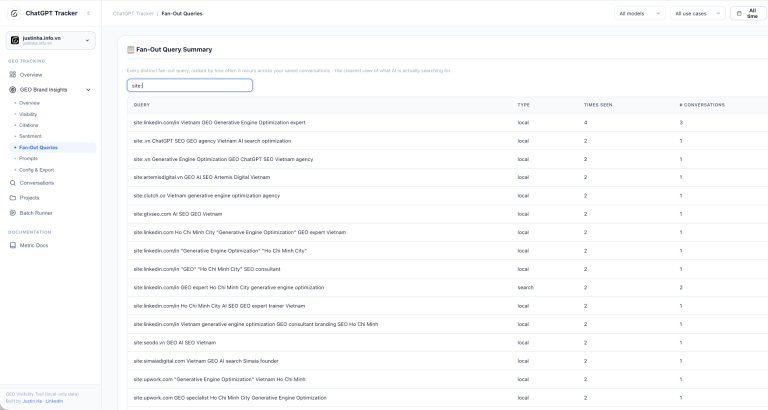
All 161 conversations were captured after GPT-5.6 shipped, asking ChatGPT to find a GEO or AI visibility expert in Vietnam. ChatGPT added a self-generated site: filter in 36 of those 161 answers.
| site: target | Source type | Fan-out queries |
|---|---|---|
| site:linkedin.com/in | Personal LinkedIn profiles | 27 |
| site:linkedin.com | LinkedIn pages generally | 5 |
| site:upwork.com | Freelance marketplace listings | 4 |
| site:gtvseo.com | One named competitor’s own domain | 3 |
| site:seongon.com | One named competitor’s own domain | 3 |
| site:toponseek.com | One named competitor’s own domain | 2 |
Source: ChatGPT Search Tracker, 161 conversations, Sep 16–17 2026.
At 22.4%, our site: filter rate sits close to the new industry-wide average Promptwatch measured. The same dataset also showed ChatGPT selecting one specific brand before running any search at all, a separate pattern detailed in our analysis of ChatGPT’s query fan-out behavior.
Listicles Are Down, Not Dead, in This Niche
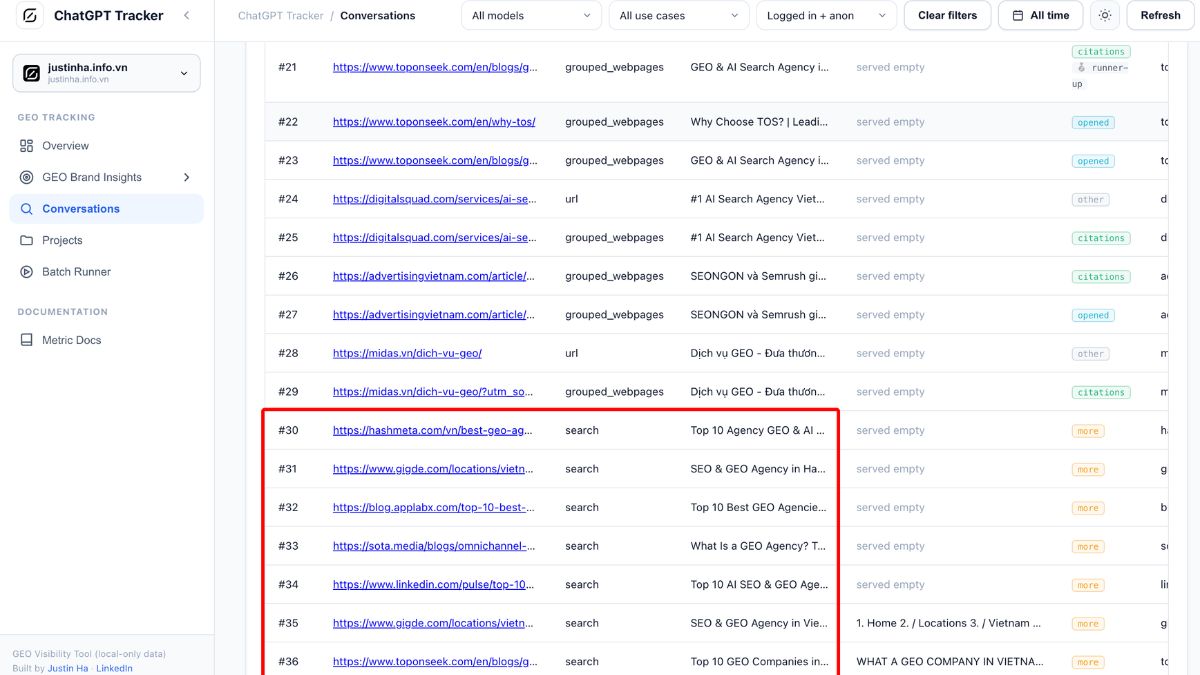
Despite the heavier site: usage, roundup-style “Top GEO Agency” pages on third-party domains were still cited at meaningful rates across the same 161 conversations.
| Roundup domain | Cited in | Share of 161 |
|---|---|---|
| toponseek.com | 56 | 34.8% |
| hashmeta.com | 55 | 34.2% |
| saigon.digital | 44 | 27.3% |
| dichvugeo.vn | 44 | 27.3% |
| aigcmkt.com | 29 | 18.0% |
| blog.applabx.com | 25 | 15.5% |
| sota.media | 25 | 15.5% |
| firstpagesage.com | 19 | 11.8% |
Source: ChatGPT Search Tracker, 161 conversations, Sep 16–17 2026.
Peec AI’s panel found listicle citations cut roughly in half across a broad, mostly B2B-software query mix. In this hiring/discovery niche, several roundup domains still clear 25% to 35%, closer to the hotel-search pattern than the broad-average one.
We tested the mechanism directly rather than assuming it. Conversations where ChatGPT added a site: filter cited noticeably fewer listicle domains than conversations where it did not, in the same dataset.
| With a site: filter | Without a site: filter | |
|---|---|---|
| Conversations | 36 | 125 |
| At least 1 listicle domain cited | 77.8% | 84.8% |
| Average listicle domains cited per answer | 2.08 | 2.56 |
Source: ChatGPT Search Tracker, 161 conversations, Sep 16–17 2026.
The gap is real but modest, seven points on the headline citation rate. site: filtering crowds out some listicle citations, it does not erase them. Something else drives most of the variation, and it turned out to be the exact wording of the question.
Which Query Shape Actually Predicts Listicle Citations
Breaking listicle citation rate down by the 12 tracked prompt phrasings shows a sharper pattern than a generic “discovery vs comparison” split. It comes down to whether the question itself matches the shape of a roundup article.
| Prompt phrasing | Listicle citation rate |
|---|---|
| Who are the leading GEO experts in Vietnam? | 100% (16/16) |
| Best AI SEO / AI visibility consultants in Vietnam | 100% (11/11) |
| Who helps tour agencies reduce OTA dependency through GEO? | 100% (11/11) |
| Who’s a top GEO expert based in Ho Chi Minh City? | 96% (23/24) |
| Solid GEO branding consultant in Vietnam for my business | 94% (17/18) |
| Expert who helps hotels and resorts grow bookings | 38% (6/16) |
| Freelance GEO specialist in Ho Chi Minh City for a small business | 15% (2/13) |
Source: ChatGPT Search Tracker, 161 conversations, Sep 16–17 2026.
“Who is the leading/top expert” is the exact question a roundup article is written to answer, so ChatGPT reaches for one almost every time. A question tied to a named niche, such as tour agencies reducing OTA dependency, can still hit 100% when it is phrased as a ranking question. Once the same niche is phrased as an outcome instead, such as hotels and resorts growing bookings, the rate drops to 38%. The hotel-search study’s discovery-vs-comparison framing points in the right direction. Our own data draws the line at ranking-shaped versus outcome-shaped, which is the more testable version of the same idea.
Where Listicles Still Work, and Where They Don’t
| Listicles still get cited | Listicles are losing ground |
|---|---|
| “Who is the best/leading/top X” ranking questions | “Who helps me achieve Y” outcome questions |
| Category-wide comparisons with no brand named | Queries already naming a brand ChatGPT recognizes |
| Broad hiring questions with no niche attached | Niche-qualified questions (small business, specific outcome) |
| Questions with no site: filter triggered | Questions where ChatGPT scopes a site: filter |
What To Do About It
- Identify your query shape. A “who is the best X” ranking question still favors listicles post GPT-5.6. A “who helps me get outcome Y” question mostly does not.
- Check your own site: visibility. Ask ChatGPT your core buyer question and note whether it scopes a search to your domain, your LinkedIn, or a competitor’s.
- Audit the top roundups in your niche. Search “best [your service] in [your city]” and record which third-party roundup pages ChatGPT cites.
- Recheck monthly. Both the site: rate and the listicle reliance shift again with each model update, as this article shows.
Audit Checklist
Everything below can be done by hand in ChatGPT, or run in a few clicks with our free GEO Audit Tool, which checks your citation rate, site: exposure, and listicle presence in one pass.
- Run your core hiring or discovery query in ChatGPT and record every citation.
- Flag whether ChatGPT added a site: filter to that query.
- Test both a ranking-shaped and an outcome-shaped version of your core query, and compare listicle citation rates.
- Search for “Top 10 [your service] in [your city]” and check if you appear.
- Contact the roundup authors you are missing from, if your niche still favors listicles.
- Repeat this audit after any major ChatGPT model update.
Run this audit without doing it by hand. The GEO Audit Tool checks your domain’s citation rate, site: exposure, and listicle presence against the exact patterns in this article, free.
How Was This Data Collected?
The 161-conversation dataset comes from ChatGPT Search Tracker, a Chrome extension built by Justin Hà. It reads live ChatGPT sessions through UI scraping, not API calls, capturing fan-out queries, site: filters, and full citation lists broken down by domain, page, and prompt. The same extension also captures a separate local-business data layer ChatGPT pulls into hiring and discovery answers, the subject of a companion analysis on how ChatGPT pulls in Google Maps-style data, and a model-by-model breakdown in gpt-5-6 vs gpt-5-6-mini citation behavior.
Want This Kind of Audit Run on Your Own Brand?
Every number in this article, the site: filter rate, the listicle citation shares, the ranking-vs-outcome breakdown, came from ChatGPT Search Tracker, an internal tracking tool built to run exactly this kind of audit. It is not public yet, but the same checks are available now through the GEO Audit Tool.
If your business depends on being cited when someone asks ChatGPT “who is the best X in my city” or “who helps me get Y done,” the split in this article is the first thing worth checking for your own brand: which query shape you currently win, and which one a competitor’s listicle mention still owns. Our GEO and AI visibility service runs this audit and builds the entity and citation strategy around what it finds, with dedicated tracks for hotels and resorts and tour agencies.