ChatGPT Decides Who Wins Before It Searches: Proof From 285 Real Conversations
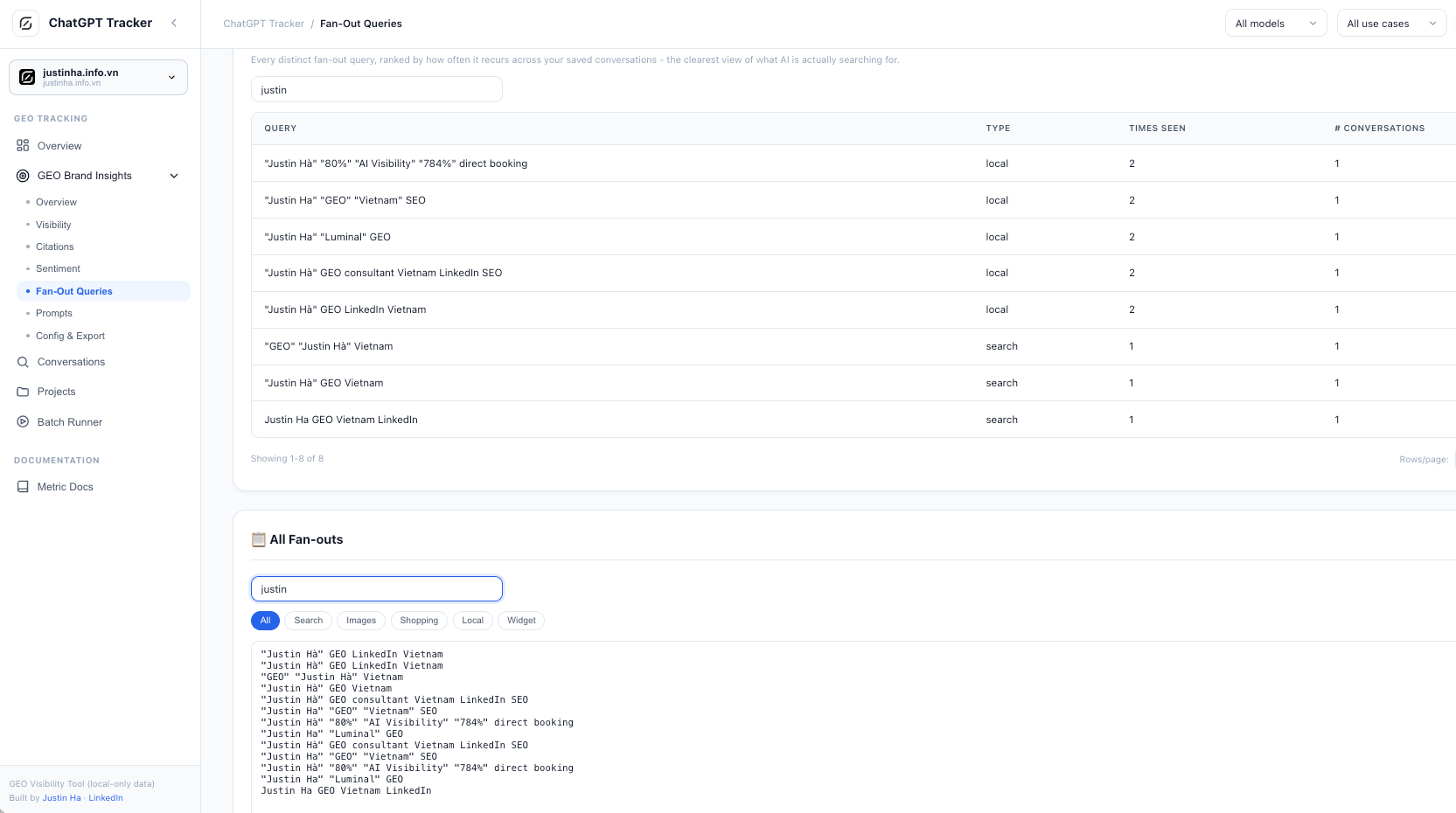
- ChatGPT wrote the search query "Justin Hà" "80%" "AI Visibility" "784%" direct booking before running any search, in two separate datasets captured two weeks apart, proving the brand was selected pre-search on more than one occasion.
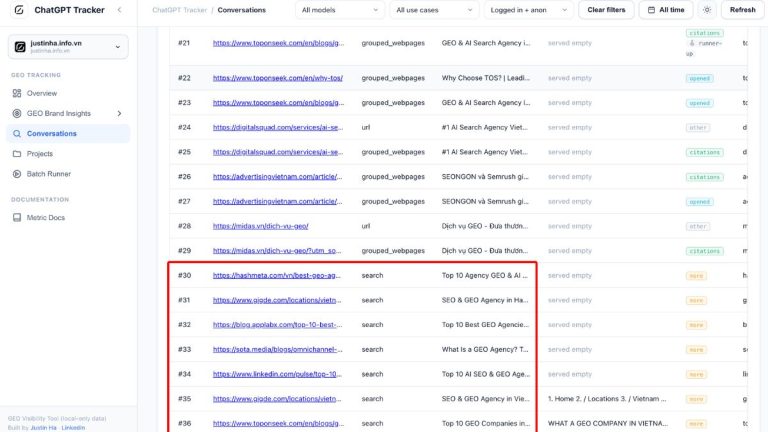
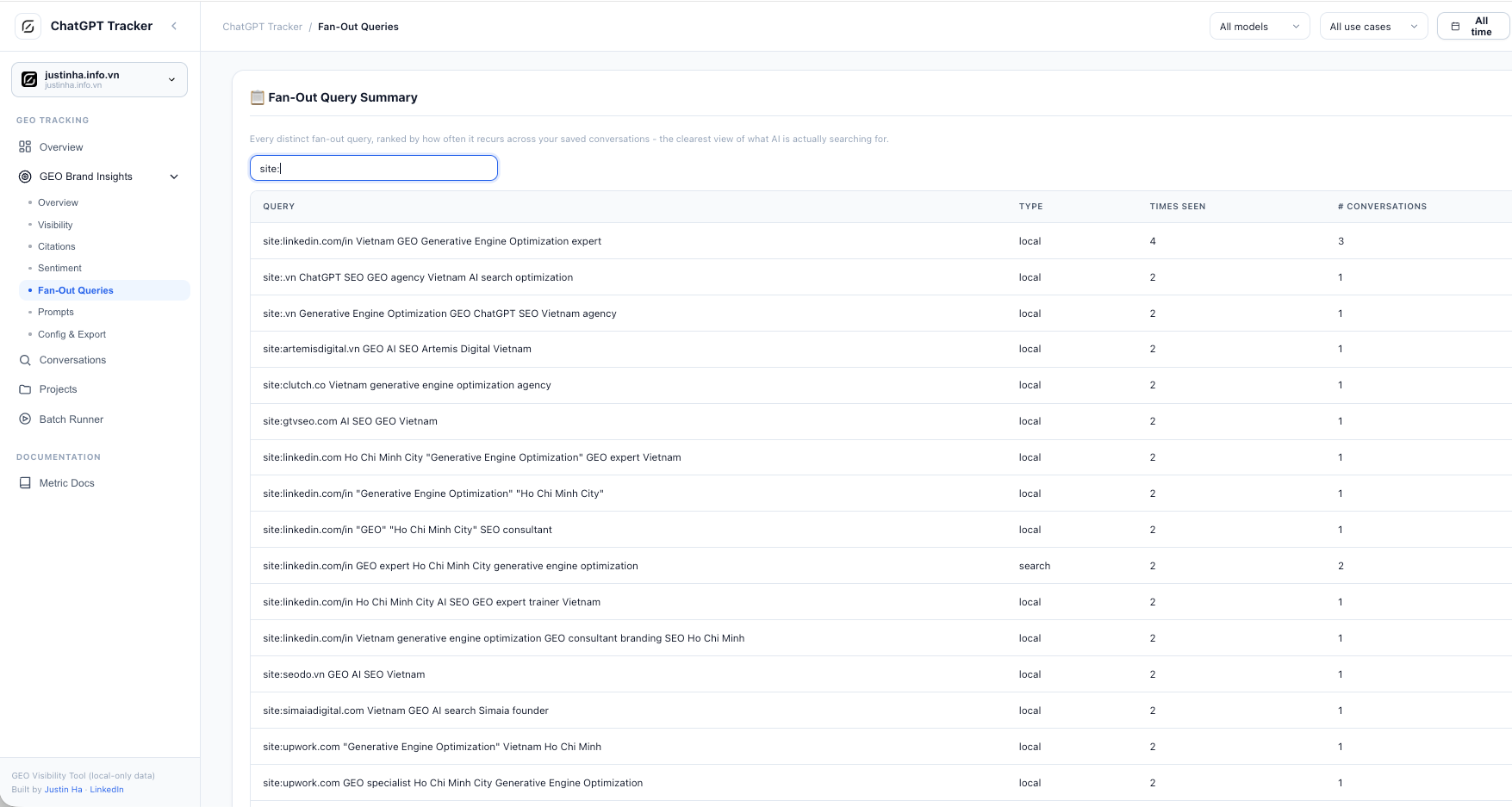
- ChatGPT added a self-generated site: filter in 54 of 124 conversations in Dataset 1 (43.5%) and 36 of 161 in Dataset 2 (22.4%), sorting sources into .vn sites, LinkedIn profiles, freelance platforms, and even single competitor domains.
- justinha.info.vn was cited in 113 of 124 answers in Dataset 1 (91.1%) and 154 of 161 in Dataset 2 (95.7%), consistently ahead of every tracked competitor.
- Across 9 tracked competitor domains in Dataset 2, citation share ranges from 83.2% (closest competitor) down to 5.6% (furthest competitor), a 15x spread inside one query set.
- ChatGPT generated almost 30 different descriptions of the same brand across 124 chats in Dataset 1, never repeating the exact wording twice.
- All data was captured with ChatGPT Search Tracker, a free Chrome extension that reads live ChatGPT sessions via UI scraping (no API calls) to expose hidden fan-out queries, site: operators, and citations.
ChatGPT often picks a brand before it runs a single search. This claim rests on two separate, independently captured datasets from ChatGPT Search Tracker, a free Chrome extension built to measure AI Visibility inside ChatGPT. Dataset 1 covers 124 conversations across 10 days (Aug 31 to Sep 10), 2 models (gpt-5-6 and gpt-5-6-mini), and 12 prompts. Dataset 2 covers 161 conversations captured over roughly 22 hours (Sep 16 to Sep 17), the same 2 models, and 20 prompt variants built from a 10-question core set. Together, that is 285 tracked conversations. All prompts asked ChatGPT to find a GEO or AI visibility expert in Vietnam, using 100% temporary chats with no history or memory.
What Is Query Fan-Out in ChatGPT Search?
Query fan-out is the set of sub-queries ChatGPT generates internally before it writes a final answer. ChatGPT does not search once. It breaks one user question into several smaller searches, runs each one, then merges the results into a single response. The final answer looks like one clean paragraph, but it is built from multiple hidden queries the user never sees.
Does ChatGPT Pick a Brand Before It Searches?
Inside the fan-out queries collected for one Dataset 1 answer, one exact search string stands out. ChatGPT wrote this query itself, before running the search and before writing the final answer.
Query fan-out: “Justin Hà” “80%” “AI Visibility” “784%” direct booking
Those two numbers, 80% AI Visibility and 784% direct booking growth, come from Justin Hà’s own published case study. The model already had this name and these numbers before any search ran. The search step that followed was a verification step, not a discovery step. The final answer confirmed a choice ChatGPT had already made.
A Second, Independent Dataset Reproduces the Same Query
Dataset 2 was captured two weeks later, on a different day, with a different (larger) prompt set built around variants like “Who’s a top GEO expert based in Ho Chi Minh City” and “Best AI SEO / AI visibility consultants in Vietnam.” Dataset 2’s 161 conversations split 77 to gpt-5-6 and 84 to gpt-5-6-mini, a split examined in full in our gpt-5-6 vs gpt-5-6-mini citation comparison.
Inside Dataset 2, the exact same fan-out string reappeared, word for word and number for number: “Justin Hà” “80%” “AI Visibility” “784%” direct booking. This is not one lucky capture. Two independently run tracking sessions, two weeks apart, with a different mix of prompts, produced the identical pre-search query.
Why this matters. That repetition is the strongest evidence that ChatGPT keeps a stable, recallable association between a brand name and specific case study numbers, and reaches for it before searching, rather than discovering it fresh each time.
Does ChatGPT Use site: Search Operators?
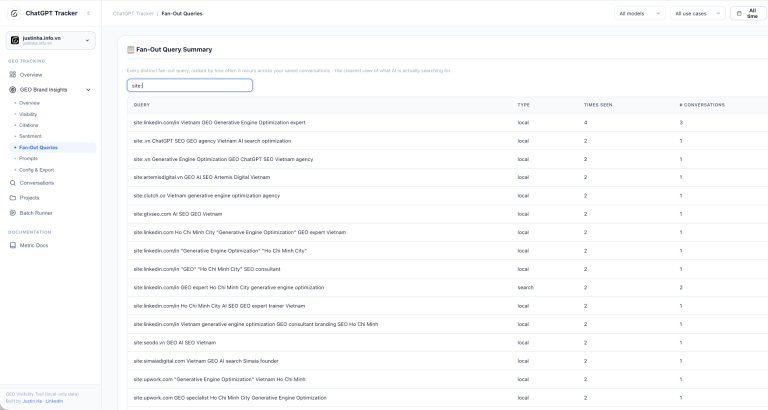
ChatGPT added a site: filter on its own in both datasets, though at different rates. In Dataset 1, this happened in 54 of 124 answers (43.5%). In Dataset 2, it happened in 36 of 161 answers (22.4%). No user typed that operator in either dataset. ChatGPT generated it internally to narrow the search to one type of source before scanning results, the same site-scoping behavior tracked across a wider dataset in our GPT-5.6 listicle citations analysis.
| site: target | Source type | Fan-out queries in Dataset 2 |
|---|---|---|
| site:linkedin.com/in | Personal LinkedIn profiles | 27 |
| site:linkedin.com | LinkedIn pages generally | 5 |
| site:upwork.com | Freelance marketplace listings | 4 |
| site:gtvseo.com | One named competitor’s own domain | 3 |
| site:seongon.com | One named competitor’s own domain | 3 |
| site:toponseek.com | One named competitor’s own domain | 2 |
| site:.vn | Vietnamese company and agency websites | 2 |
Source: ChatGPT Search Tracker, Dataset 2, 161 conversations, Sep 16–17 2026.
Dataset 1 showed the same category-level pattern with site:.vn, site:linkedin.com/in, and site:upwork.com. Dataset 2 adds a sharper detail: ChatGPT sometimes scopes a search to one single competitor’s domain by name, such as site:gtvseo.com or site:seongon.com, effectively fact-checking one named brand’s own site before writing about it.
Which Domains Get Cited Most by ChatGPT?
A small group of domains receives most of the citations, and this held steady across both datasets. In Dataset 1, justinha.info.vn was cited in 113 of 124 conversations (91.1%). In Dataset 2, a larger and separately captured batch, justinha.info.vn was cited in 154 of 161 conversations (95.7%), the same page-level breakdown examined in our analysis of which pages ChatGPT actually cites.
| Domain | Cited in (Dataset 2) | Share of 161 conversations |
|---|---|---|
| justinha.info.vn | 154 | 95.7% |
| hingewise.com | 134 | 83.2% |
| toponseek.com | 115 | 71.4% |
| ktdigital.vn | 82 | 50.9% |
| fastmarketing.com.vn | 73 | 45.3% |
| dat.info.vn | 46 | 28.6% |
| headsonpillows.com | 40 | 24.8% |
| seodao.vn | 25 | 15.5% |
| roi300.com | 24 | 14.9% |
| seongon.com | 14 | 8.7% |
| gtvseo.com | 9 | 5.6% |
Source: ChatGPT Search Tracker, Dataset 2, 161 conversations, Sep 16–17 2026.
Citation share does not spread evenly across the web. Even within one narrow query set (GEO experts and consultants in Vietnam), citation share ranges 15x from the top domain to the bottom tracked domain. A domain outside the top few stays close to invisible in ChatGPT answers, no matter how much content it publishes.
Does ChatGPT Save a Fixed Description of a Brand?
ChatGPT does not save one fixed profile of a brand. Across 124 conversations in Dataset 1, ChatGPT generated close to 30 different short descriptions of the same name, and never repeated the exact same wording twice.
ChatGPT writes a new description on each run, built from whatever content it finds in that session. A website, a LinkedIn profile, and a bio need to state the same facts in the same order. One strong page is not enough, because ChatGPT does not read from a saved card. It rebuilds the description from scratch every time.
Check Where Your Brand Sits in ChatGPT’s Fan-Out Right Now
The same checks that produced every number in this article, fan-out query capture, site: filter detection, and domain citation share, can be run on your own brand with the free GEO Audit Tool.
- Ask your core hiring question in ChatGPT and check whether your case study numbers or name show up before the search runs.
- Note whether ChatGPT scopes a site: filter to your domain, your LinkedIn, or a named competitor.
- Record every domain cited in the answer and rank them, not just whether you appear.
- Collect 3 to 5 different short descriptions ChatGPT gives your brand and check if they repeat the same facts.
- Repeat the test two weeks later, as this article did, to see what stays stable.
Skip the manual tracking. The GEO Audit Tool runs this fan-out and citation audit for you, free.
How Was This ChatGPT Data Collected?
This data comes from ChatGPT Search Tracker, a Chrome extension built by Justin Hà. The extension works through UI scraping, not API calls. It reads the live ChatGPT session directly in the browser, so the captured data reflects exactly what ChatGPT does in real time, including hidden fan-out queries, self-generated site: filters, and per-conversation citation lists that never appear in the visible chat window.
Frequently Asked Questions
What is query fan-out in ChatGPT?
Query fan-out is the set of internal sub-queries ChatGPT runs before writing a final answer. ChatGPT splits one user question into several smaller searches, then merges the results into one response.
Can I see what ChatGPT searches for behind the scenes?
Standard ChatGPT users cannot see fan-out queries in the interface. ChatGPT Search Tracker captures this data by reading the live session stream, exposing the hidden search steps ChatGPT runs before an answer appears.
Does ChatGPT ever search a competitor’s own website directly?
Yes. In a 161-conversation dataset, ChatGPT ran fan-out queries scoped to single named competitor domains, such as site:gtvseo.com and site:seongon.com, appearing to verify a specific brand against its own site before citing it.
Why does ChatGPT cite the same domains repeatedly?
ChatGPT ranks and reuses domains it already trusts for a topic. A small set of domains earns most of the citation share, based on prior visibility and content structure, which explains why citation counts concentrate on a few sites rather than spreading evenly.
Is ChatGPT Search Tracker free to use?
Yes. ChatGPT Search Tracker is 100% free. It is built for freelancers and small agencies running GEO measurement on a limited budget.
Want This Kind of Tracking Built Around Your Own Brand?
ChatGPT Search Tracker is an internal tool, not public yet. It tracks five data points in every conversation, AI Visibility, Share of Voice, Citations, Entities, and Query Fan-Out, including multi-competitor benchmarking like the leaderboard above, so a brand’s visibility across models can be monitored over time, not just checked once.
The same checks are available now through the free GEO Audit Tool. If you want the fan-out capture, competitor benchmarking, and citation strategy built around your own brand rather than run as a one-off audit, our GEO and AI visibility service sets that up end to end.