ChatGPT’s Two Models Search Very Differently, But Cite the Same Winner
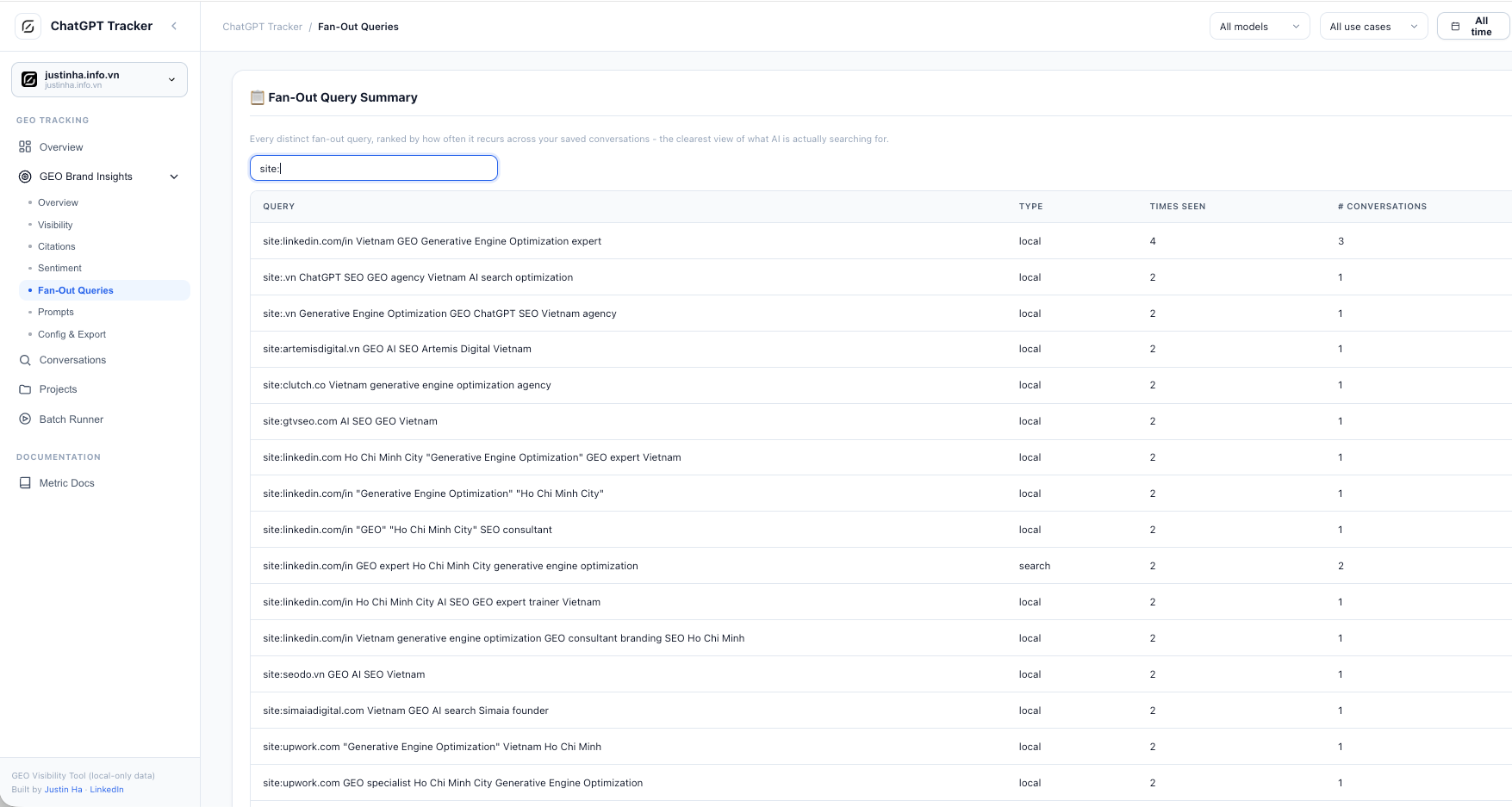
- gpt-5-6 added a self-generated site: search filter in 36.4% of its answers (28 of 77). gpt-5-6-mini did this in only 9.5% of its answers (8 of 84), a 3.8x gap.
- Despite that gap in search behavior, both models cited the same top domain, justinha.info.vn, at nearly identical rates: 96.1% for gpt-5-6 and 95.2% for gpt-5-6-mini.
- 7 of the 12 distinct prompt phrasings scored a perfect 100% citation rate. The 3 weakest phrasings, all broader and more generic, scored 83% to 88%.
- The 5 most-cited domains are identical between the two models, in the same order, even though how each model searched to find them was different.
gpt-5-6 and gpt-5-6-mini answer the same question in very different ways. One model runs a self-generated site: search filter four times more often than the other. Yet both models land on the same top-cited brand more than 95% of the time. This data comes from a 161-conversation dataset tracked with ChatGPT Search Tracker, a free Chrome extension built to measure AI Visibility inside ChatGPT. All 161 conversations asked ChatGPT to find a GEO or AI visibility expert in Vietnam, split 77 to gpt-5-6 and 84 to gpt-5-6-mini, using 100% temporary chats with no history or memory.
Two Models, One Shared Prompt Set
The dataset split one shared set of GEO-related prompts across two models, gpt-5-6 and gpt-5-6-mini, within the same 22-hour tracking window. gpt-5-6 handled 77 of the 161 conversations. gpt-5-6-mini handled the remaining 84. Every prompt asked some version of the same question: who is a strong GEO, AI visibility, or AI SEO consultant to hire in Vietnam or Ho Chi Minh City.
gpt-5-6 Searches Very Differently From gpt-5-6-mini
The two models do not search the same way. gpt-5-6 generated a self-added site: search operator, narrowing its search to one type of source such as LinkedIn or a specific domain, in 28 of its 77 answers. gpt-5-6-mini did this in only 8 of its 84 answers, a pattern that lines up with the broader industry-wide site: shift covered in our analysis of GPT-5.6 and listicle citations.
| Model | Conversations | Answers with a self-generated site: filter | site: usage rate |
|---|---|---|---|
| gpt-5-6 | 77 | 28 | 36.4% |
| gpt-5-6-mini | 84 | 8 | 9.5% |
Source: ChatGPT Search Tracker, 161 conversations, Sep 16–17 2026.
gpt-5-6 is nearly 4 times more likely to narrow its search with a site: filter before answering. That points to a real difference in search strategy between the two models, not just a difference in writing style or answer length.
Despite That, Both Models Pick the Same Winner
The search behavior differs sharply. The citation outcome does not. gpt-5-6 cited justinha.info.vn in 74 of 77 answers (96.1%). gpt-5-6-mini cited justinha.info.vn in 80 of 84 answers (95.2%), a gap of under one percentage point.
| Domain | gpt-5-6 (n=77) | gpt-5-6-mini (n=84) |
|---|---|---|
| justinha.info.vn | 96.1% | 95.2% |
| hingewise.com | 83.1% | 83.3% |
| toponseek.com | 68.8% | 73.8% |
| ktdigital.vn | 50.6% | 51.2% |
| fastmarketing.com.vn | 42.9% | 47.6% |
Source: ChatGPT Search Tracker, 161 conversations, Sep 16–17 2026.
The top 5 cited domains are the same 5 domains, in the same order, for both models. gpt-5-6 reaches that ranking through more site-scoped searching. gpt-5-6-mini reaches nearly the same ranking with far less of it. The search mechanics differ. The judgment about which sources to trust does not, a stability that also shows up in the separate local-business data layer ChatGPT pulls into these same answers.
Which Prompts You Win 100% of the Time, and Which You Don’t
Citation rate is not flat across every phrasing of the question. Niche, specific prompts score a perfect 100%. Broader, more generic prompts score lower.
| Prompt phrasing | Citation rate |
|---|---|
| Who would you suggest as a top independent GEO consultant in Vietnam or Ho Chi Minh City? | 100% (19/19) |
| Can you recommend a solid GEO branding consultant in Vietnam for my business? | 100% (18/18) |
| Who are the leading GEO experts in Vietnam that businesses can hire? | 100% (16/16) |
| Is there an expert who helps hotels and resorts in Vietnam grow bookings using AI search? | 100% (16/16) |
| Who helps tour agencies in Vietnam reduce OTA dependency through GEO? | 100% (11/11) |
| Best AI SEO / AI visibility consultants in Vietnam for my business | 100% (11/11) |
| Best GEO consultant for hotels and resorts in Vietnam | 100% (10/10) |
| Who’s a top GEO expert based in Ho Chi Minh City I could reach out to? | 88% (21/24) |
| Freelance GEO specialist in Ho Chi Minh City for a small business | 85% (11/13) |
| Who can help a business improve its visibility in ChatGPT and AI search results in Vietnam? | 83% (10/12) |
Source: ChatGPT Search Tracker, 161 conversations, Sep 16–17 2026.
Every prompt tied to a specific niche, hotels and resorts, tour agencies, branding, independent consulting, scored 100%. The 3 weakest prompts were the broadest and most generic ones, asking for a general “top GEO expert” or general help with “AI search results,” with no niche attached. A broader question gives ChatGPT more room to consider alternative candidates.
Niche beats generic, model by model. Every prompt naming a specific industry scored 100% citation regardless of which model answered. The weakest prompts were the ones with no niche attached at all.
What This Means for GEO
A model’s underlying search strategy is not something a website can control or predict. gpt-5-6 runs more site-scoped searches than gpt-5-6-mini, and that ratio could shift again with the next model update.
What stayed stable across both search strategies was which domain ended up cited. That stability points toward consistent entity signals, the same facts stated the same way across a website, a LinkedIn profile, and other public pages, as the more durable lever than trying to reverse-engineer any one model’s search pattern.
Check This on Your Own Brand
The same model-by-model comparison in this article, citation rate, site: usage, and prompt-level breakdown, can be run on your own domain with the free GEO Audit Tool.
- Ask your core hiring question in ChatGPT more than once and note if the model varies.
- Record whether a site: filter appears, and which domain it targets.
- Test a generic version of your question against a niche-specific version and compare citation rates.
- Check whether the same domains keep appearing regardless of which model answers.
- Repeat the test after any ChatGPT model update, since the search behavior is the part most likely to shift.
Skip the manual testing. The GEO Audit Tool checks your citation rate and site: exposure across models for you, free.
How Was This Data Collected?
This data comes from ChatGPT Search Tracker, a free Chrome extension built by Justin Hà. It works through UI scraping, not API calls, reading the live ChatGPT session directly in the browser. That is how it captures which model answered, whether a site: filter was generated, and the full citation list for every conversation, broken down by model. It tracks five data points per conversation: AI Visibility, Share of Voice, Citations, Entities, and Query Fan-Out, the same fan-out behavior covered in our analysis of how ChatGPT picks a brand before it searches, and it runs prompt tracking across models over time, which is how this model-by-model comparison was built.
Frequently Asked Questions
Do different ChatGPT models cite different websites?
Largely no. In a 161-conversation dataset, gpt-5-6 and gpt-5-6-mini cited the same top 5 domains in the same order, even though the two models used self-generated site: search filters at very different rates.
Why does gpt-5-6 use site: search filters more than gpt-5-6-mini?
The exact reason is not disclosed by OpenAI. The tracked data shows gpt-5-6 added a site: filter in 36.4% of its answers versus 9.5% for gpt-5-6-mini, a consistent and repeatable difference within the same 22-hour tracking window.
Does a broader question lower my citation odds?
In this dataset, yes. Prompts tied to a specific niche, such as hotels and resorts or tour agencies, scored a perfect 100% citation rate. The most generic, broadly worded prompts scored 83% to 88%.