Why AI Bots Crawl Your Site But Never Cite You (And How to Fix It)
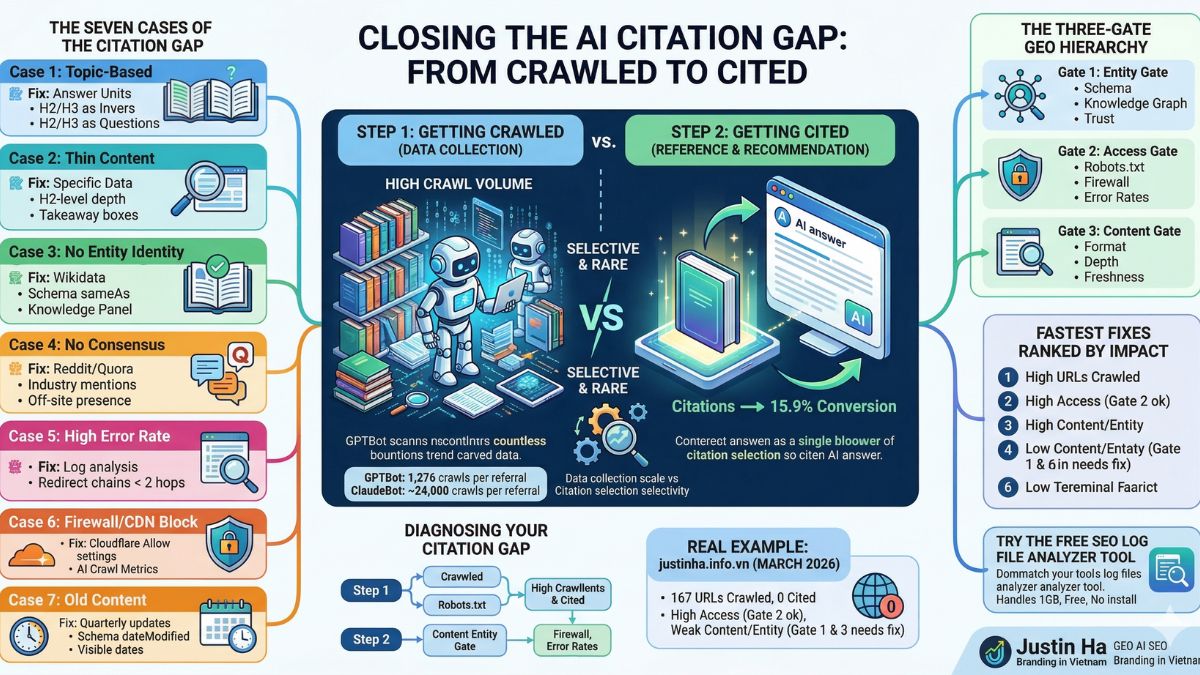
- Being crawled and being cited are separate events. In one real example, a site scored 85/100 GEO grade with 167 URLs crawled successfully, yet had 0 citations, a pure content-structure problem, not a crawling problem.
- ClaudeBot crawls ~24,000 pages per referral sent back; GPTBot runs ~1,276:1 (Cloudflare Radar, Jan–Mar 2026). Crawling happens at massive scale, citation is rare and selective.
- There are 7 specific reasons a site gets crawled but not cited, and they sort into 3 sequential gates: Entity (is the brand a recognized entity), Access (can bots actually read the pages), and Content (is it structured for extraction).
- Most GEO work focuses only on the Content gate. If the Entity or Access gate is closed, content work alone produces zero citations.
- Structured content with real depth is 2.8x more likely to be cited than thin content; domains active on Reddit/Quora have ~4x higher citation odds, and on G2/Capterra/Trustpilot ~3x higher.
- Fastest fixes ranked by impact: fix firewall/CDN blocking first (minutes), then 404/500 errors, then Organization schema with sameAs, then answer-first content restructuring, then off-site entity signals, then refreshing stale content.
- Diagnosis is a 4-step process: check the log file for bot activity, test AI citation rate directly with real prompts, check entity signals by asking AI what it knows about the brand, then audit content against the answer-unit format.
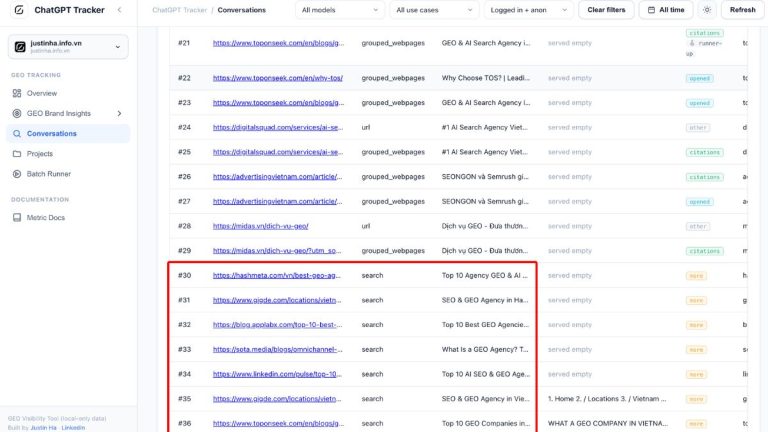
A server log file shows GPTBot, ClaudeBot, and OAI-SearchBot visiting a site regularly, confirming they are reading pages and getting successful 200 responses. But asking ChatGPT or Perplexity a question in that niche returns a competitor instead, one with less content and less traffic.
This is the AI citation gap. Being crawled and being cited are two completely separate things. Getting crawled is step one. Getting cited requires passing several additional tests that have nothing to do with how often a bot visits.
| Bot | Crawl-to-referral ratio |
|---|---|
| ClaudeBot | ~24,000 pages crawled per referral sent |
| GPTBot | ~1,276 pages crawled per referral sent |
Source: Cloudflare Radar, Jan–Mar 2026.
Understanding the Gap: Crawling vs Citing
When an AI bot crawls a page, it collects the raw text and stores it, that is all. Citation is a separate decision made later, when a user asks a question and the model decides which sources are worth referencing.
A library researcher might scan thousands of books looking for material, but a report only cites the books that gave a clear, direct, trustworthy answer to a specific question. The rest were read but not cited. There are 7 distinct cases that explain this gap, each with a different fix.
Case 1: Your Content Does Not Answer a Specific Question
AI systems are built around question-answering. If pages are written around topics and keywords rather than questions and answers, the AI cannot extract a clean, citable answer even after reading every word.
The fix: rewrite section headers as real questions, then make the first sentence under each header a direct, complete answer. This is called an answer unit, three parts: a direct claim first, supporting detail in the body, and a clear takeaway at the end.
Example rewrite. Instead of the header “GEO Strategy Benefits,” use “What are the benefits of a GEO strategy?” then open with: “A GEO strategy helps a brand appear in AI-generated answers across ChatGPT, Perplexity, and Google AI Overviews.” A complete, citable answer in one sentence.
Case 2: Your Content Is Too Thin to Establish Authority
Structured pages with real depth are 2.8 times more likely to be cited than thin content. A service page that lists offerings without explaining how, why, or with what results is thin. So is a blog post answering a question in three paragraphs without data or specifics.
The fix: add specific, precise data to every key claim and name sources when using statistics. Go deeper than feels necessary, a 600-word article that fully resolves a question outperforms a 2,000-word article that circles the point. Add a summary or “Key Takeaway” block AI models can extract as citation-ready snippets.
Case 3: Your Brand Has No Entity Identity in AI Knowledge Graphs
AI models try to map a brand to a stable entry in an internal knowledge graph, its name, what it does, who is behind it, where it appears across the web. Without a clear, consistent identity across trusted sources, the model cannot confirm the brand is real and trustworthy, and will not cite it even with excellent content. This is the entity gate, and content quality is never even considered until it passes.
Documented case. A brand’s name overlapped with a common English word, and AI models kept confusing the two. Adding a sameAs link in schema markup, connecting the brand to its Wikidata entry, resolved the confusion within three weeks. Citations followed shortly after.
The fix: claim a Wikidata entry, add Organization schema with sameAs links to Wikidata, LinkedIn, and Crunchbase, and work toward a Google Knowledge Panel through consistent brand mentions and NAP data. Make About pages and author bios specific: years of experience, project count, markets served.
Case 4: Your Content Has No Consensus Signals from Other Sources
Domains active on G2, Capterra, Trustpilot, or Yelp have roughly 3x higher citation chances. Domains with real mention activity on Reddit and Quora have roughly 4x higher chances than domains that exist only on their own site. A single website claiming to be the best is noise; multiple independent sources saying the same thing is consensus, which is why Wikipedia gets cited so often.
The fix: build presence on the platforms AI systems actively learn from. Thoughtful, well-supported Reddit contributions drive citation likelihood far more than quick comments. LinkedIn articles and YouTube videos add further consensus. A single mention in a credible publication does more for citation rate than ten new pages on the same domain.
Case 5: Your Site Has a High Error Rate That Blocks AI Access
A log file may show bots crawling, but a share of those requests may return errors. In one log file analyzed for this report, 13% of all requests returned errors, above the 10% danger threshold, and 10% of AI requests specifically failed, about 87 failed AI requests across 15 days. Sites with repeated errors get crawled less often and less deeply over time.
The fix: filter a log file to AI bot user agents combined with 4xx/5xx codes, sorted by frequency. Add 301 redirects for 404s with a live equivalent, return 410 Gone for deleted content with none, and flatten redirect chains longer than two hops.
Case 6: Your Content Is Blocked by a Firewall or CDN
This case is invisible in the log file, which makes it dangerous. If a CDN or WAF blocks AI bot requests before they reach the server, those requests never appear in the logs at all. Cloudflare changed its default configuration in 2024 to block AI bots, and many WordPress owners had bot access silently cut off without realizing it, even with an open, correct-looking robots.txt.
Three gates, not one. There is robots.txt, the firewall/CDN, and the indexing gate (noindex, canonical mismatches). Most SEOs only check the first. The second and third are where silent blocking happens most often.
The fix: in Cloudflare, check Security → Bots → AI Scrapers and Crawlers, and confirm it is set to Allow. For other CDNs or WAFs, check IP allowlists against the published ranges for OpenAI, Anthropic, and Google. After changes, wait 24–48 hours and confirm previously missing bots now appear in the log.
Case 7: Your Content Is Too Old or Has Not Been Updated Recently
Citations in AI responses average about 26% newer than those in traditional search results. 79% of AI bots mainly index content from the past two years, and 65% focus on the current year. Content older than three months sees meaningfully fewer citations than freshly updated content on the same topic.
The fix: set a quarterly review schedule for the most important pages, update statistics, and keep a visible “Last Updated” date with dateModified in schema. Prioritize the pages a log file shows bots revisit most often, and always add real new content, not just a changed date, AI systems can tell the difference.
The Three-Level GEO Hierarchy You Must Pass Before Getting Cited
The seven cases sort into a sequence of three gates. All three must pass before citation becomes possible.
| Gate | What it covers | Cases |
|---|---|---|
| 1. Entity | Can the AI identify the brand as a real, trustworthy entity: schema, knowledge graph signals, off-site mentions, consistent identity | Case 3, Case 4 |
| 2. Access | Can the AI actually read the pages: robots.txt, firewall/CDN, JavaScript rendering, error rates, redirects | Case 5, Case 6 |
| 3. Content | Is content structured and deep enough to extract a clean, citable answer: answer-first format, depth, freshness | Case 1, Case 2, Case 7 |
Most GEO practitioners focus almost entirely on Gate 3, rewriting content and adding FAQs. If Gate 1 or Gate 2 is failing, that work produces zero citations. Confirm Gates 1 and 2 are open before investing heavily in content optimization.
How to Diagnose Your Own Citation Gap
- Check the log file for AI bot activity. Search for GPTBot, OAI-SearchBot, ClaudeBot, meta-externalagent, PerplexityBot, and ChatGPT-User. 200 codes mean Gates 1 and 2 are at least partially open; mostly 4xx/5xx means a Gate 2 problem; no appearance at all means check the firewall and CDN first. The AI Log File Analyzer gives a full breakdown, free, up to 1GB.
- Test the AI citation rate directly. Ask ChatGPT, Perplexity, Claude, and Google AI Overviews 10 to 20 real audience questions, and note which sources get cited. If weaker competitors are cited and the brand is not, the problem is likely Gate 1 or Gate 2. If no one in the niche is cited consistently, the problem is likely Gate 3.
- Check entity signals. Ask ChatGPT or Claude “what do you know about [brand]?” A vague or incorrect answer means the entity gate is not passing. Check for an active Wikidata entry, a Google Knowledge Panel, and Organization schema with sameAs links.
- Audit content structure. Test the 5 most important pages against the answer-unit format: direct answer first, at least one specific named data point, questions as headers, a summary section. If most fail, Gate 3 is the priority once Gates 1 and 2 are confirmed working.
A Real Example: 167 URLs Crawled, 0 Cited
| Metric | Result |
|---|---|
| GEO score | 85/100, Grade A |
| Unique URLs crawled by AI bots | 167, 90% success rate |
| Crawl trend | +362% week-over-week |
| AI referral visits | 24 |
| Citations from those visits | 0 |
Source: GEO Log Analyzer report, justinha.info.vn, March 2026.
This is a textbook Gate 3 problem on top of a strong Gate 2 performance. The bots access the site easily and return frequently, Gate 2 is open, but content structure and entity signals are not yet strong enough to cross the citation threshold. The fix here was answer-first restructuring and deeper content on the /geo/ section, which received only 3% of AI traffic despite being the most important section.
The Fastest Fixes Ranked by Impact
- Fix firewall and CDN blocking (Gate 2). The fastest win. If Cloudflare or a WAF is silently blocking AI bots, fixing it takes minutes and immediately opens the site to crawling and citation consideration.
- Fix 404 and 500 errors for AI bots (Gate 2). Each error is a page the bot cannot read. Fix the highest-frequency errors first, one to two days of work with immediate impact on crawl success.
- Add Organization schema with sameAs (Gate 1). A one-time technical task, a few hours, linking to Wikidata, LinkedIn, and Crunchbase, with compounding impact over time.
- Restructure the top 5 pages with answer-first format (Gate 3). Rewrite headers as questions, add answer units. Typically one to two weeks of work, with citation results within four to eight weeks.
- Build off-site entity signals (Gate 1). Reddit contributions, LinkedIn expert content, one industry publication mention per month. Slower, a two to three month horizon, but builds lasting consensus.
- Update stale content with fresh data (Gate 3). Audit the most-crawled pages, update statistics, add new examples, refresh dateModified. Ongoing work.
Frequently Asked Questions
How long does it take to get cited after fixing the issues?
Firewall fixes can show results within 24 to 48 hours once bots crawl successfully. Entity signal fixes through schema typically show results within two to four weeks. Content restructuring typically produces citation results within four to eight weeks for search-based tools like Perplexity and OAI-SearchBot. Training-based improvement in ChatGPT’s base model takes longer, tied to model update cycles.
Does having more pages crawled increase citation chances?
Not directly. A site with 20 well-structured, authoritative pages that pass all three gates gets cited more often than a site with 500 thin pages that fail Gate 3. More pages that each pass all three gates does increase total citation surface area across more topics.
Does robots.txt need to explicitly allow each AI bot?
No. If robots.txt does not mention a specific bot, it is allowed by default. Explicit Allow rules only matter if a broad Disallow rule would otherwise block everything. The most important check is confirming no rule intended for something else, like blocking bots from an admin area, is accidentally blocking AI bots too.
Why is PerplexityBot crawling my site but Perplexity never cites me?
PerplexityBot crawls broadly to build its index. Citation requires passing all three gates, and Perplexity places especially high weight on content directly answering the query and on external authority signals, including sources discussed on Reddit. If content is not being discussed externally, Perplexity may crawl it but choose better-validated sources.
What is the minimum content depth needed to get cited?
There is no word count minimum. A 500 to 600 word article with perfect answer-unit structure, specific data, and clear attribution can outperform a 3,000 word article with vague, unstructured content. The real question is whether a section gives a complete, specific, citable answer, not how long it is.
From Citation Gap to Full GEO Visibility
Closing the AI citation gap means passing three gates in sequence: entity, access, and content. Most sites fail at one without knowing which. A log file answers Gate 2. Direct AI testing answers Gate 1. Content auditing answers Gate 3.
Our GEO AI SEO Branding service runs a full three-gate audit covering entity signals, technical access, and content structure, tested across ChatGPT, Perplexity, Google AI Overviews, and six other AI platforms, followed by a prioritized fix plan and monthly prompt testing.
Start with the log file. Upload it to the AI Log File Analyzer, free, no sign-up, handling files up to 1GB, to see every bot’s success rate and error pattern. Book a free consultation to turn the diagnosis into a fix plan.