What Is LLMs.txt, LLMs-full.txt?
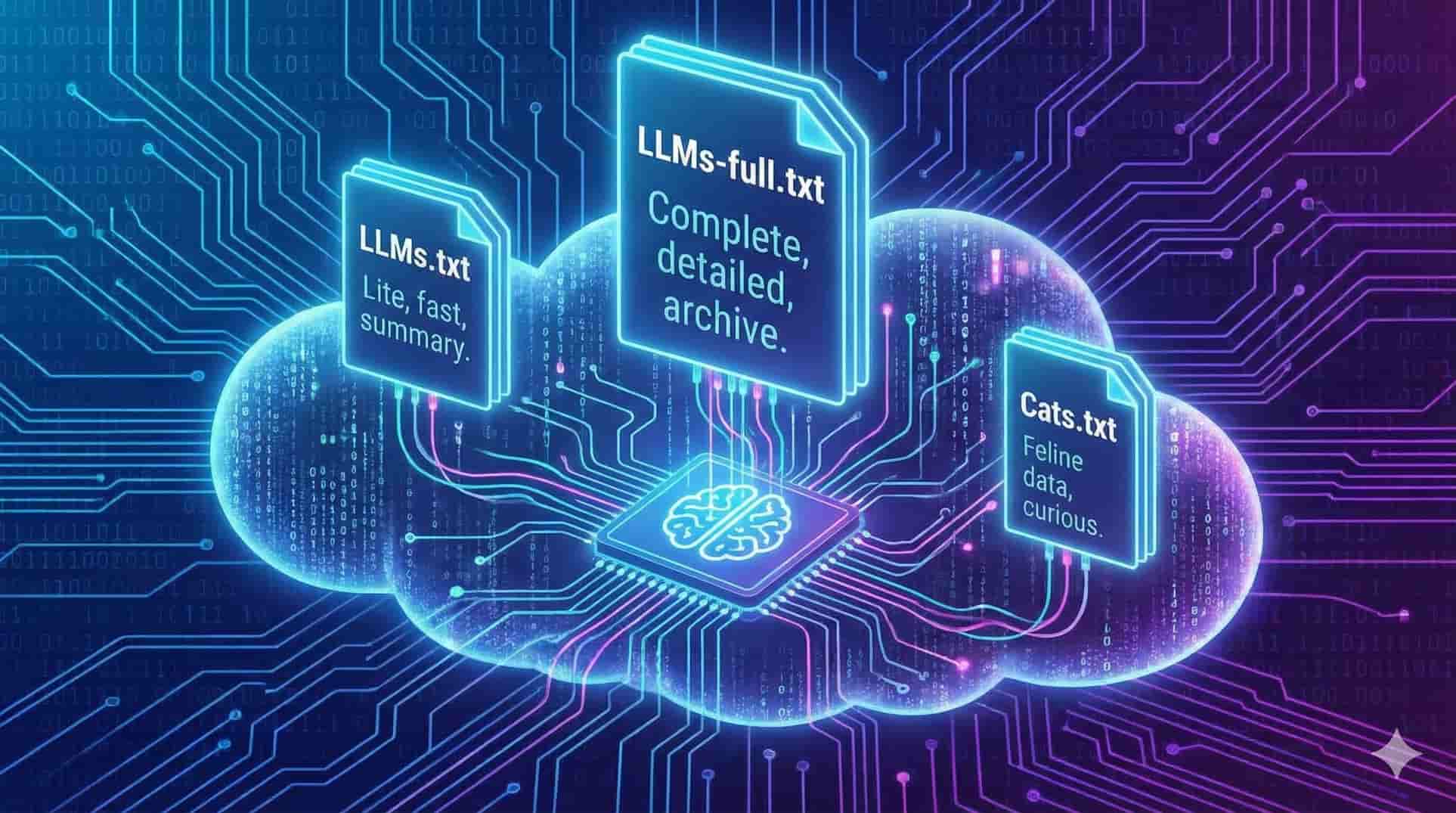
- llms.txt and llms-full.txt are two plain text files that directly tell AI crawlers (GPTBot, PerplexityBot, and others) how to index, prioritize, and cite a brand's content.
- llms.txt (~38 lines) is a permission and policy file establishing trust; llms-full.txt (~300+ lines) is a content priority index listing the 20–50 best pages.
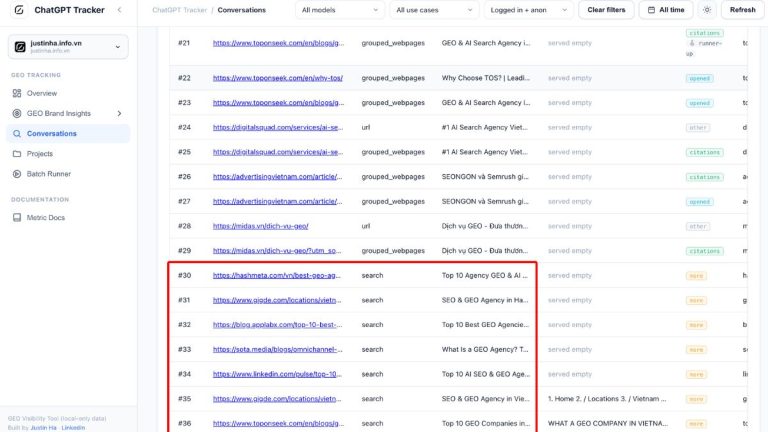
- AI engines select only 2–7 sources per answer from thousands of candidates; these files reduce evaluation time and increase citation probability.
- Recommended rollout: llms.txt in week 1, llms-full.txt in week 2, then monitor citations for 4–8 weeks before expecting consistent results.
- These files are not mandatory, AI systems still find and cite content without them, but they meaningfully speed up and sharpen how AI evaluates a brand.
- A working example of each file is published live at justinha.info.vn/llms.txt and justinha.info.vn/llms-full.txt.
These two files are a direct communication line to AI systems. They tell ChatGPT, Perplexity, Google AI Overviews, and Gemini exactly how a brand wants to be understood, prioritized, and cited. To understand why they matter, it helps to first understand how modern AI systems actually work.
| Number | What it measures |
|---|---|
| 2–7 | Sources an AI engine typically selects per answer, out of thousands of candidates |
| 4–8 weeks | Time to first AI visibility improvements for lower-competition queries |
| 80% | Brand visibility reached by a hospitality client 3 months after a full technical GEO setup, including these files |
What Are llms.txt and llms-full.txt?
How AI Systems Find and Cite Content
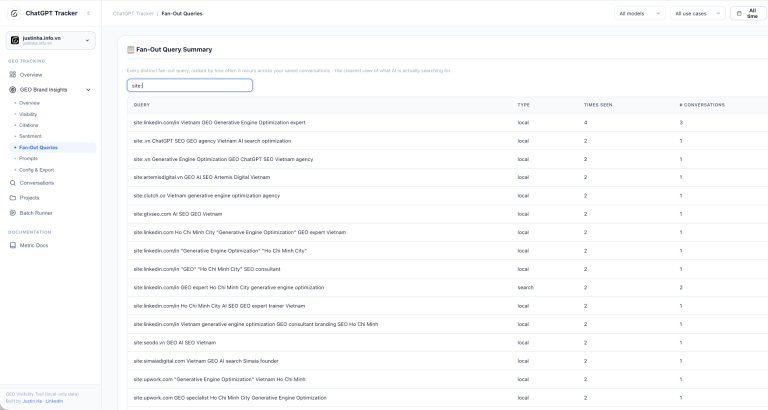
When a user asks ChatGPT “who should I hire for [service]?” or “what’s the best [product] for [use case]?”, the AI doesn’t simply return a ranked list of websites. It performs a multi-step process, the same fan-out mechanism documented in our analysis of how ChatGPT picks a brand before it searches.
| Process stage | Description |
|---|---|
| 1. Live search | The AI conducts a live search across the internet, analyzing hundreds or thousands of potential sources relevant to the query. |
| 2. Evaluation | It evaluates each source: semantic clarity, topical authority, entity recognition, and E-E-A-T signals. |
| 3. Selection | It selects 2–7 sources that meet these criteria, not always the top Google rankings, but sources AI systems recognize as credible and well-structured. |
| 4. Synthesis and citation | It synthesizes a direct answer and includes citations: “According to [Brand], [fact]. Source: [URL]” |
Critical insight. A website can rank #1 in Google but never be cited by ChatGPT if it lacks the structural clarity, semantic organization, and entity signals AI systems prioritize. This is the fundamental difference between SEO and GEO, covered in full in our GEO fundamentals guide.
The Two Files and Their Specific Purposes
llms.txt: Permission and Policy
What it is: A public text file in the root directory that communicates how AI systems should interact with the site’s content.
What it tells AI systems:
- AI crawlers such as GPTBot and PerplexityBot are welcome to index the site
- How content should be attributed when cited
- Whether commercial use is permitted
- Licensing and usage terms
- Which pages represent the brand most authoritatively
- How to make contact regarding licensing or partnerships
Format: Roughly 38 lines of plain text: a header, 4–5 introductory paragraphs, and 8 section links.
Why AI systems use it: llms.txt is the first signal AI crawlers look for. It tells them immediately that a brand understands AI search and has explicitly welcomed indexing, which creates trust. A domain without it must be evaluated through a slower, more cautious process, the same evaluation lag covered in our crawl budget and log file guide.
llms-full.txt: Content Priority Index
What it is: A comprehensive manifest of the 20–50 best pages, organized with metadata explaining which content matters most and what each page covers.
What it tells AI systems:
- Which pages are the most authoritative and should be prioritized
- Each page’s topic, authority level (cornerstone vs. supporting vs. supplementary), and last-updated date
- A Quick Facts table: company profile, credentials, scale, expertise areas
- Differentiators and competitive advantages
- Case studies with specific results and outcomes
- Methodology and how problems get solved
- Answers to common customer questions
Format: Roughly 300+ lines: a Quick Facts table, service descriptions, case studies, an FAQ section, and a detailed content inventory.
Why AI systems use it: When ChatGPT or Perplexity discovers thousands of potentially relevant pages, llms-full.txt filters them: “among all my content, these are the ones I trust most.” This dramatically increases the probability the best content gets selected for citation.
- llms.txt is the permission and policy file. Its main function is signaling that AI systems are welcome and linking to key pages. Update it annually.
- llms-full.txt is the content priority index. Its main function is listing the 20–50 best pages with authority levels and metadata. Update it quarterly.
The two-layer approach. Layer 1 (llms.txt) establishes trust: “I welcome your crawlers.” Layer 2 (llms-full.txt) guides prioritization: “these are my best resources.” Together they tell AI systems a brand is credible, organized, and worth citing.
Why These Files Matter for AI Search
When ChatGPT or Perplexity generates an answer, it doesn’t rank websites like Google does. It selects 2 to 7 sources that meet specific criteria: trustworthiness, semantic clarity, topical authority, and proper attribution. These files directly influence whether a brand gets selected.
| With proper implementation | Without structured AI files |
|---|---|
| Explicitly guided to the 20–50 best pages, with authority level and topic metadata | AI must guess which of 1,000+ pages are most important |
| Structured files signal trust, cutting evaluation time to days or hours | AI crawlers cautiously evaluate the site over weeks |
| llms.txt states citation preferences explicitly, increasing citation confidence | Attribution uncertainty, AI may misrepresent the brand or hesitate to cite |
| Competing with the small number of sites that implement these files | Competing with 10,000+ sites for a single citation slot |
- llms.txt creates trust. The moment an AI crawler arrives, llms.txt says “I welcome your crawlers,” which accelerates evaluation and builds immediate credibility.
- llms-full.txt guides selection. Among hundreds of pages, it flags which ones represent real expertise, and ChatGPT prioritizes explicitly-flagged authoritative content.
Real result. A hospitality client reached 80% brand visibility across ChatGPT and AI Mode within 3 months of implementing a complete technical GEO setup, including these files.
Real Examples: How Professional Brands Use These Files
Example 1: An Actual llms.txt Implementation
- Credentials
- 4+ years SEO, 2 years GEO, based in Ho Chi Minh City, Vietnam.
- Primary specialty
- Hospitality growth: helping restaurants, hotels, and resorts reduce OTA dependency through direct bookings and brand building, the same specialization behind the Holiday Inn Saigon Airport and Cucina Luca results.
- Scale and reach
- 30+ projects across Vietnam, US, UK, Australia, and Asia, spanning e-commerce, healthcare, tourism, retail, education, and beauty.
- Methodology
- Semantic SEO and Topical Authority, building comprehensive content architecture for sustainable AI-era growth.
- AI value
- Helps brands win visibility in ChatGPT, Perplexity, AI Mode, and Google AI Overviews through semantic architecture and entity optimization.
Example 2: A SaaS Company Implementation
- Focus
- 9+ years enterprise software, 3 years AI automation, 180+ implementations, 50+ active clients.
- Key results
- 80% process automation in finance, compliance automation in healthcare, 340% ROI within 12 months in manufacturing.
- Why this works
- It immediately establishes credibility, scale, and measurable outcomes, the exact signals AI systems look for when deciding what to cite.
Example 3: A Luxury Furniture Brand Implementation
- Credentials
- 12+ years luxury design, 4 years direct-to-consumer sales, based in Milan, Italy.
- Portfolio
- 150+ custom commissions across Europe and North America, including a Dubai penthouse, a NYC showroom, and a Milan boutique hotel.
- Unique angle
- Globally sourced materials combined with heritage craftsmanship, positioning luxury furniture as investment pieces in AI search.
See a Real Working Implementation
Both of these files are published live and can be opened directly:
- View llms.txt, the actual permission and policy file: header format, 4 opening paragraphs, 8 clean sections.
- View llms-full.txt, the complete profile: Quick Facts table, differentiators, ideal clients, services, case studies, methodology, and FAQ.
Study the format. These files serve as an exact template. Open each one in a text editor to see the precise formatting, structure, and language patterns that work with AI systems, then customize for another brand.
Creating llms.txt (about 30 minutes)
- Open a plain text editor. Notepad, TextEdit, or VS Code. Never Word or Google Docs.
- Write the header.
# [Name] | [Title]followed by> [Credentials with location]. - Write 4 to 5 opening paragraphs. Specialty, then scale, then methodology, then AI value.
- Create 8 sections. Overview, About, Experience, Pricing, Case Studies, Blog, Contact, Full Reference.
- Save and upload. Save as
llms.txtand upload to the root:yourdomain.com/llms.txt. - Test it. Open the URL in a browser. It should display as plain text, not download.
Creating llms-full.txt (2 to 3 hours)
| Component | What to include |
|---|---|
| Quick Facts | 14 key attributes: name, title, founded, location, education, experience, projects, markets, website, LinkedIn, email, phone. |
| Differentiators | 5 points on what makes the brand unique, bold title plus a 1–2 sentence explanation each. |
| Ideal clients | A primary focus paragraph, plus 3–5 secondary industries as bullets. |
| Services | 2–3 detailed service descriptions with pricing. |
| Pricing tables | Packages, prices, durations, and key outcomes. |
| Work experience | 4+ positions with dates, 3–4 bullets per role with specific metrics. |
| Case studies | 4+ cases: client type, service, timeline, result, approach, full link. |
| Methodology | 5 numbered phases describing the process. |
| FAQ | 10+ questions on methodology, results, timeline, client fit, measurement. |
| Tools and stack | Tools listed by category: SEO, content, monitoring, and so on. |
The Universal Formula: Works Across All Industries
Whether the brand is hospitality, SaaS, luxury, healthcare, or B2B, the formula stays consistent. Every effective llms.txt includes the same elements.
- Header. Name and title in an exact format, credentials stated immediately in the tagline.
- 4 paragraphs. Specialty, then scale, then methodology, then value, each serving a specific purpose in building credibility.
- 8 sections. A consistent structure from Overview through Contact.
- Specific metrics. Numbers like 30+ projects, 80% visibility, 150+ clients build credibility.
- AI platforms named. ChatGPT, Perplexity, Google AI, Gemini, specific about where the brand optimizes.
- Roughly 38 lines. Compact and scannable, professional tone, no fluff.
Why this works. This formula mirrors how AI systems evaluate brand authority: who are you, what have you done, how many people have you helped, how do you do it, what results do you create. Each section answers one of these questions in a way AI systems understand.
Recommended Implementation Timeline
- Week 1: llms.txt. Create and deploy it, then allow 5–7 days for AI crawlers to process.
- Week 2: llms-full.txt. Create and deploy it, then allow 5–7 days for crawlers to integrate it.
- Weeks 3–7: monitor. Begin tracking AI citations across ChatGPT, Perplexity, Google AI, and Gemini with the GEO Audit Tool.
- Months 3–6: expect compounding. Progressive improvement in AI visibility and citation frequency.
Timeline reality. Some brands see early AI visibility improvements within 4–8 weeks for lower-competition queries. Consistent, broad AI citation presence typically develops over 3–6 months. The phased rollout lets AI crawlers properly integrate each file before adding the next.
Frequently Asked Questions
Are these files mandatory?
No, they’re not mandatory. AI systems will find and cite content without them. Implementing these files significantly improves citation probability by explicitly communicating content priorities and expertise areas. Most brands see measurable AI visibility improvement within 4–8 weeks of implementation.
Which file should be created first?
Always start with llms.txt. It establishes permissions and tells AI crawlers they’re welcome to index the site. After 5–7 days, create llms-full.txt to guide them to the best content.
How many pages should llms-full.txt include?
20 to 50 of the absolute best pages. Quality matters more than quantity: cornerstone content, ultimate guides, key product pages, and definitive resources. Including every blog post dilutes the signal.
How can I tell if these files are working?
Track brand mentions in ChatGPT, Perplexity, and Google AI using controlled prompt testing, check GA4 for traffic from openai.com and perplexity.ai, monitor branded search growth in Google Search Console, and check server logs for GPTBot and PerplexityBot requests with the AI Log File Analyzer.
What if the site runs on WordPress or another CMS?
These files can still be created and uploaded manually. Use a hosting file manager (cPanel, Plesk) or an FTP client to upload .txt files to the root directory (/public_html for WordPress). They don’t require plugins or database integration, they’re static text files accessed directly by AI crawlers.
Ready to Build AI Visibility?
These two files are the technical foundation for GEO. Implemented alongside semantic content architecture and entity optimization, as covered in our full SEO/GEO process, they create a compounding effect where AI visibility grows month after month.
- Run an AI Visibility Audit across ChatGPT, Perplexity, Gemini, and Google AI Overviews
- Build semantic content architecture and entity optimization
- Set up llms.txt, schema, and knowledge graph presence
- Run monthly prompt testing and AI citation tracking
- Build off-site authority on Reddit, LinkedIn, and YouTube
Not ready to talk yet? Track AI mentions and citation frequency for free with the GEO AI SEO Analytic Tool. Packages start from USD 600/month, available for restaurants, tour agencies, and any brand competing for AI citations. See the full GEO and AI visibility service or book a free consultation.