
SEO Case Study: How a luxury brand scaled organic and AI visibility through informational content?
How a Luxury Brand Scaled Organic and AI Visibility Through Informational Content
No backlinks. No content volume. Just 40 articles, a rebuilt site architecture, and a semantic strategy designed for how search systems actually understand information. The result: 5,400% more AI sessions and 474 keywords appearing in AI Overviews — from zero.
The Challenge: Luxury Brand, Global Market, Zero AI Presence
Luxury goods present a unique SEO challenge. The audience is high-intent but low-volume. Keywords are competitive but often unaddressable through traditional tactics alone. And increasingly, buyers in the luxury segment — interior designers, architects, high-net-worth homeowners — begin their discovery journey not on Google's results page, but by asking an AI.
When this project began in April 2024, the client had zero presence in AI search: 0 keywords appearing in Google AI Overviews, minimal organic footprint across four languages, and 17,000 monthly sessions split across the US, UK, and Australian markets. The brief was to grow all of these — without building backlinks and without publishing content for volume.
The constraint was also the strategy. By removing backlink-building and content inflation from the equation, every decision had to be built on what search systems and AI engines actually reward: semantic clarity, structural coherence, and topical authority by design.
Before & After: The Full Picture
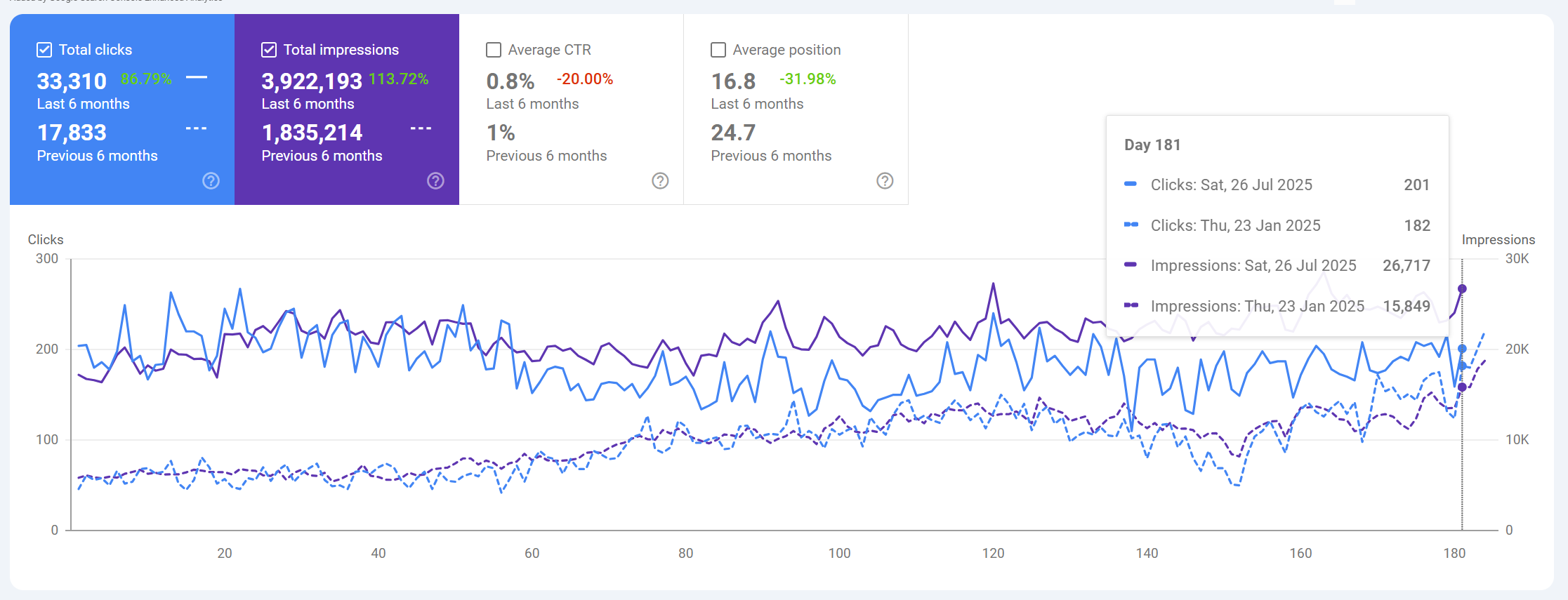
This growth was not driven by content volume. It was driven by making the website understandable — not just crawlable. Every metric above improved because search systems and AI engines could resolve the site's meaning, authority, and relevance with precision.
The Strategy: Semantic Architecture Over Content Volume
The project began not with content, but with a complete rebuild of the site's information architecture. The website was restructured with semantic HTML and a clear entity-based hierarchy — designed around how search systems connect information, not just how they index it.
Only 40 informational articles were published across the entire 15-month campaign. Each article was mapped to a specific role within the Topical Map — functioning as a node in a structured knowledge graph, not as a standalone piece of content. No article was written for volume. No article was written to cover a keyword. Every article was written to resolve a specific gap in the site's semantic completeness.
The foundation was rebuilt first. Semantic HTML, logical heading hierarchies, entity-structured page templates, and a clear internal linking architecture gave search systems and AI engines a coherent map of what the brand is, what it offers, and how its knowledge is organized.
Every piece of content was designed within a Topical Map before being written. Articles were chunked, embedded, and structured to fill specific roles: hub pages, spoke pages, definitional anchors, and contextual bridges. No content existed without a defined purpose within the semantic hierarchy.
Topical Authority was built by designing the site around how search systems connect entities — not by expanding keyword sets. The brand, its products, materials, styles, and use contexts were established as a coherent entity cluster, allowing AI systems to understand the brand's domain of expertise with precision.
Content was written to be declarative, context-rich, and easy to resolve — not just easy to read. Each article explicitly states what a concept is, why it matters, and how it relates to adjacent concepts. This is why 474 keywords now surface in AI Overviews: AI engines can extract a confident answer from every page.
Client case studies were integrated as part of the informational ecosystem — not as isolated testimonials. Each case study reinforced real-world relevance and demonstrated expertise in specific contexts (material type, room application, design style), feeding E-E-A-T signals directly into the topical authority structure.
The same semantic architecture was applied across four languages — English, Spanish, German, and French — with hreflang implementation and consistent entity mapping across all language variants. This ensured that authority signals accumulated across markets rather than fragmenting between them.
From Zero to 474: The AI Overview Breakthrough
The metric that best illustrates what this strategy achieved is the AI Overview keyword count: from 0 to 474 keywords appearing in Google AI Overviews over 15 months, with no backlink building and only 40 articles published.
AI Overviews do not surface content because it ranks well. They surface content because AI systems can extract a confident, well-attributed answer from it. A page that ranks #1 for a keyword will not appear in an AI Overview if its content is ambiguous, shallow, or poorly structured. A page that ranks #8 will appear if its content is declarative, authoritative, and semantically complete.
This is the proof of concept at the core of this case study: semantic clarity is the new backlink. When a page is written so that a search system — human or AI — can resolve exactly what it is about, who it is for, and why it is authoritative, it earns citation across both traditional and AI-driven surfaces simultaneously.
After each Broad Core Algorithm Update, organic and AI visibility increased. No corrective actions were needed — reinforcing that the site's semantic structure and clarity matched exactly what modern ranking systems reward.
The Core Update Test: Built Right, Rewarded Consistently
Google's broad core algorithm updates are the industry's most reliable indicator of whether a site's SEO strategy is genuinely sound or just temporarily gaming ranking signals. Sites built on surface-level optimization — keyword stuffing, link schemes, thin content — typically lose visibility after core updates. Sites built on genuine semantic authority typically gain it.
This site was tested by multiple broad core updates over the 15-month campaign period. After each one, organic and AI visibility increased. No corrective actions were taken. No content was removed, revised, or disavowed. The updates functioned exactly as intended — rewarding a site built for clarity and punishing those built for manipulation.
When a site is built to be genuinely understandable — with semantic structure, entity clarity, and declarative content — algorithm updates become tailwinds, not threats. The site does not need to recover from updates because it is always aligned with what ranking systems reward.
Semantic HTML implementation, information architecture design, entity mapping across four languages. No content published until the structural foundation was in place.
40 informational articles published in a sequenced rollout — each mapped to its role within the Topical Map. Hub pages, definitional anchors, and contextual bridges deployed in dependency order. Case studies integrated as informational ecosystem nodes.
AI Overview keywords begin surfacing as the entity graph matures. Organic sessions cross 30K monthly. First form submissions arrive — entirely from organic. Core update encountered: visibility increases, no corrective action required.
AI sessions grow from 2 to 110 as AI Overview visibility expands to 474 keywords. Keywords in Top 3 grow from 150 to 406. Second and third core updates encountered — both result in further visibility gains. Form submissions reach 178.
45K monthly sessions, 474 AI Overview keywords, 406 Top 3 positions, and 178 form submissions — all achieved with zero backlinks built and only 40 articles published over 15 months.
Key Takeaways: What This Case Study Proves
-
Architecture before content. Rebuilding the site's semantic structure before publishing a single article was the most impactful decision made. Without a coherent information architecture, additional content would have added noise rather than authority. Structure determines how search systems understand the site; content fills that structure with meaning.
-
40 excellent articles beat 400 mediocre ones. Every article had a defined role in the Topical Map. None existed for coverage or volume. This density of purpose — rather than density of content — is what allowed a small content set to generate 474 AI Overview keywords and 406 Top 3 positions.
-
Semantic clarity is the new backlink. Zero backlinks were built during this campaign. All growth came from making the website genuinely understandable to search systems and AI engines. When a site is structured as a coherent knowledge entity, it earns authority signals organically — from the quality of how information is organized, not from external link acquisition.
-
Multilingual semantic consistency multiplies authority. Applying the same entity architecture across English, Spanish, German, and French meant authority accumulated across all four language markets simultaneously. Consistent entity mapping across hreflang variants prevented authority fragmentation and allowed the brand to dominate luxury search queries in three major English-speaking markets.
-
Core updates reward semantic structure. Every algorithm update strengthened rather than disrupted this site's visibility. This is the ultimate validation: when a site is built to be genuinely understandable — not just optimized — it is permanently aligned with what ranking systems reward, regardless of how those systems evolve.
-
AI Overviews and organic rankings are now the same game. The content that earned 406 Top 3 positions also earned 474 AI Overview citations. They are not separate channels requiring separate strategies. Semantic clarity, entity authority, and declarative writing serve both simultaneously — and compound each other over time.
Ready to Make Your Website Understandable — Not Just Crawlable?
The results in this case study came from a single commitment: building a website that search systems and AI engines can genuinely understand. Justin Hà applies the same semantic architecture methodology to any brand operating in competitive, high-intent markets.
justinha.info.vn · Packages from USD 600/month · Available for luxury, e-commerce, B2B & professional services