GEO Case Study: Achieving 80% Brand Visibility across ChatGPT & AI Mode prompts within 3 months
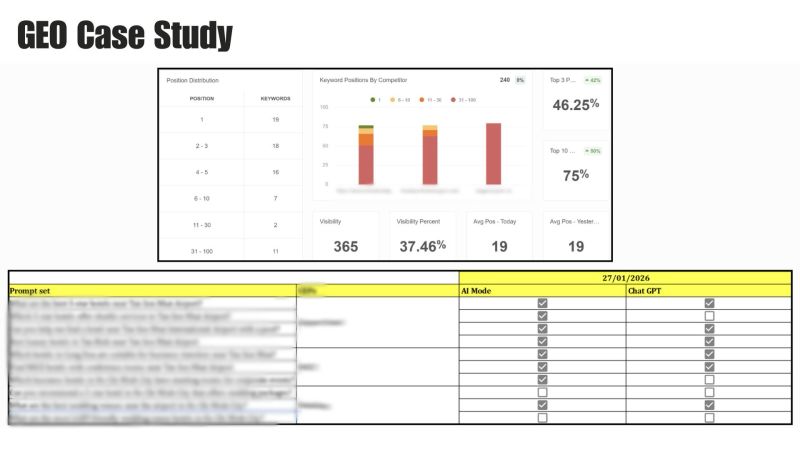
GEO Case Study: Achieving 80% Brand Visibility across ChatGPT & AI Mode Prompts within 3 Months
No paid digital PR. No backlink campaigns. Just a structurally understandable brand — and within 90 days, 8 out of 10 targeted AI prompts returned the client as a cited recommendation across ChatGPT and Google AI Mode.
The Challenge: Winning AI Recommendations in a Competitive Hospitality Market
In hospitality, discovery has always been trust-driven. Before booking, guests ask — friends, review platforms, concierges. Today, an increasing number ask AI. They type prompts like "best venue for corporate events in [city]" or "luxury hotel with conference facilities Vietnam" directly into ChatGPT or Google AI Mode and expect a synthesized, confident recommendation in return.
The client — a hospitality brand operating in the Vietnamese and English-speaking market — had strong offline reputation but limited structured AI presence. When users asked relevant prompts across ChatGPT and Google AI Mode, the brand was absent from generated responses. Competitors with weaker actual offerings were being recommended instead, simply because their digital presence was more structurally legible to AI systems.
The goal was clear and measurable: achieve meaningful brand visibility across targeted AI prompts within 3 months — without paid digital PR, without artificial citation manipulation, and without inflating content volume. The result had to come from genuine structural GEO work.
The Result: 8 Out of 10 Target Prompts — Brand Cited
Before any strategy was executed, a baseline audit was conducted across 10 representative prompts in both Vietnamese and English — the queries real users ask when searching for hospitality services of this type. At baseline, the brand appeared in zero of them. After 3 months of structured GEO implementation, the brand appeared in 8 out of 10.
The 2 remaining prompts target broader, more competitive regional queries where the brand's entity authority is still maturing. These are expected to resolve as trust signals accumulate across additional citation sources — a normal part of the GEO compounding cycle.
The GEO Strategy: Making the Brand Structurally Understandable to AI
AI visibility did not increase randomly. It increased when the brand became structurally understandable to large language models. Every element of the strategy was designed around a single question: what does an AI engine need to see — in the content, the structure, and the off-site presence — to confidently recommend this brand in response to a specific prompt?
Schema markup was implemented not at the page level, but at the entity layer — defining the business as a structured entity with properties, relationships, and service associations that AI systems could parse and attribute. This gave language models a machine-readable identity for the brand, not just a crawlable webpage.
Branding content was created specifically to align with how AI systems learn, interpret, and associate brands with commercial intent prompts. This meant declarative statements of expertise, context-rich descriptions of service scenarios, and clear positioning language that AI engines could extract and cite with confidence.
Trust sources were built strategically to support citation signals toward money pages — the direct booking and event inquiry pages that generate revenue. By building a web of credible, contextually relevant references pointing toward conversion-critical pages, AI confidence in recommending those pages increased measurably.
A full-funnel GEO content strategy was deployed, connecting informational, commercial, and transactional intent within a structured semantic ecosystem. Each content layer served a specific function in the AI citation chain — informational content built topical authority, commercial content bridged intent, transactional content received the resulting citation traffic.
Why This Worked: Structural Understanding, Not Content Volume
The most important insight from this case study is not the 80% visibility rate — it is how that rate was achieved. No volume content strategy was executed. No PR agency was engaged to seed mentions. No backlinks were built to manipulate authority signals.
What changed was the brand's structural legibility to AI systems. Language models — including ChatGPT and Google's Gemini powering AI Mode — do not simply retrieve web pages. They build a probabilistic understanding of what a brand is, what it offers, who it serves, and how credible it is. When that understanding is coherent and well-sourced, the brand gets recommended. When it is fragmented or ambiguous, the brand gets ignored — regardless of how strong its actual offering is.
AI visibility did not increase randomly. It increased when the brand became structurally understandable to large language models. The system does not recommend what it cannot confidently resolve.
The bilingual dimension added a layer of complexity that made the result more significant. Achieving 80% prompt visibility across both Vietnamese and English — two languages with different intent patterns, different AI training data densities, and different citation ecosystems — required entity consistency and content architecture that functioned coherently in both linguistic contexts simultaneously.
The 14 new conversions and 10% increase in direct event inquiries are the downstream proof. AI recommendations did not generate vanity traffic — they generated high-intent, decision-ready visitors who arrived already knowing what the brand offered and already trusting it, because an AI system had already validated that trust.
Key Takeaways: What This Case Study Proves About GEO
-
AI visibility is earned through structural clarity, not content volume. 80% prompt visibility was achieved without publishing hundreds of articles. The decisive factor was making the brand's entity, expertise, and service context structurally legible to language models — not flooding the internet with content.
-
Schema markup is the language AI systems use to understand your business. Implementing schema at the entity layer — not just the page level — gave AI engines the machine-readable vocabulary to define and attribute the brand with precision. This is the single highest-leverage technical GEO action available to any business.
-
Trust signals must point toward money pages. Building a citation architecture that directed AI confidence toward direct booking and event inquiry pages — not just general brand mentions — is what converted AI visibility into measurable revenue. Visibility without conversion architecture is wasted reach.
-
Bilingual GEO is a competitive moat. Most competitors optimize for one language. Achieving coherent AI visibility across both Vietnamese and English simultaneously requires entity consistency that is genuinely difficult to replicate. Brands that establish this early create a durable advantage in bilingual markets.
-
GEO results can compound faster than SEO. 3 months to 80% prompt visibility is a timeline that traditional SEO cannot match for equivalent impact. AI systems update their understanding continuously — meaning well-structured GEO signals can propagate into recommendation behavior faster than any organic ranking improvement.
-
AI-referred conversions are high-intent by design. Users who arrive from an AI recommendation have already received a synthesis of the brand's relevance, credibility, and suitability for their specific need. The 14 new event inquiry conversions from this campaign represent a quality of lead that paid advertising rarely matches — and they arrived at zero media cost.
Is Your Brand Visible When AI Answers Your Customers' Questions?
This client went from zero AI citations to 80% prompt visibility in 3 months — in two languages, with no paid PR. The same structured GEO methodology is available for hospitality brands, professional services, and any business where AI recommendations drive high-intent discovery.
justinha.info.vn · GEO Packages from USD 600/month · Results trackable within 60–90 days