
SEO Case Study: How “Trending Nodes” scaled 94K Discover clicks and +784% direct bookings for a Hair Salon?
How "Trending Nodes" Scaled 94K Discover Clicks and +784% Direct Bookings for a Hair Salon
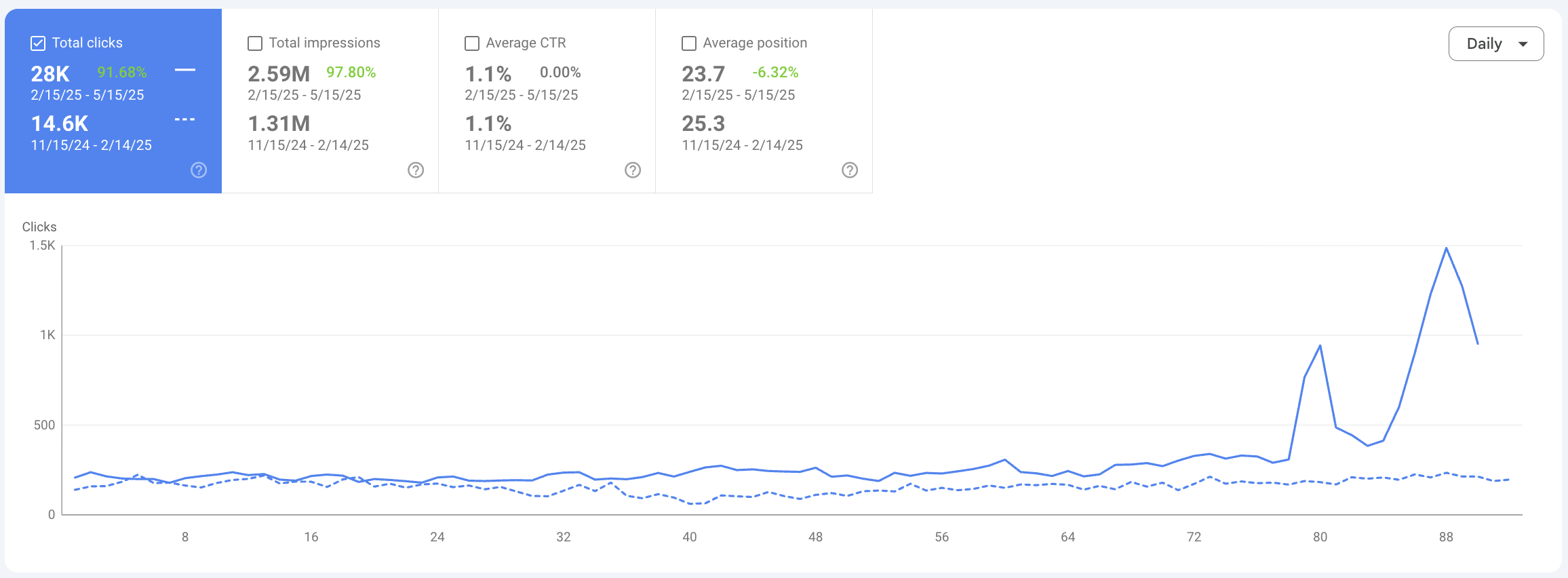
A local hair salon. A content strategy built around trending signals — not keyword volume. One article. 94,000 clicks from Google Discover. Direct bookings up 784%. Here is the full breakdown.
The Challenge: A Local Salon Competing in a Saturated Market
Hair salons are one of the most competitive local SEO verticals. Every market has dozens of them. Most fight over the same "hair salon + city" keywords, publish the same service pages, and rely on Google Business Profile alone for local visibility.
This client faced exactly that environment. The growth did not come from expanding service pages or pushing harder on "hair salon + location" keywords. It came from a completely different playbook: preparing the site to win Google Discover visibility — not just traditional search results.
The strategy recognized something most local SEO practitioners miss: local SEO no longer stops at the map pack. When a local brand earns topical authority and aligns with how Discover and AI systems surface information, visibility scales far beyond location-based queries — and bookings follow.
The Trending Nodes Strategy: How Google Discover Was Won
Google Discover operates on a fundamentally different logic from traditional search. Users do not type a query — Google proactively surfaces content it believes a user will find relevant based on their interests, behavior, and the topical signals a piece of content sends. To win Discover, content must be timely, topically clear, and visually compelling.
Instead of reacting to trends after they peaked, the content strategy aligned with how Discover typically works: topical relevance, visual clarity, and timing. Every content piece was written to explain "what is happening in the hair world right now" — not to chase keywords.
Trending hairstyles, seasonal changes, celebrity-driven looks, and treatment-specific shifts were treated as signals of real demand. These topics were framed clearly, visually, and contextually so the system could understand why this brand was relevant — not just what it offered.
This is why a single article was able to reach 94,000 clicks through Google Discover. It was not a lucky spike — it was the result of a deliberate content architecture designed to give Google's algorithm exactly the topical and visual signals it needs to confidently surface content to a mass audience.
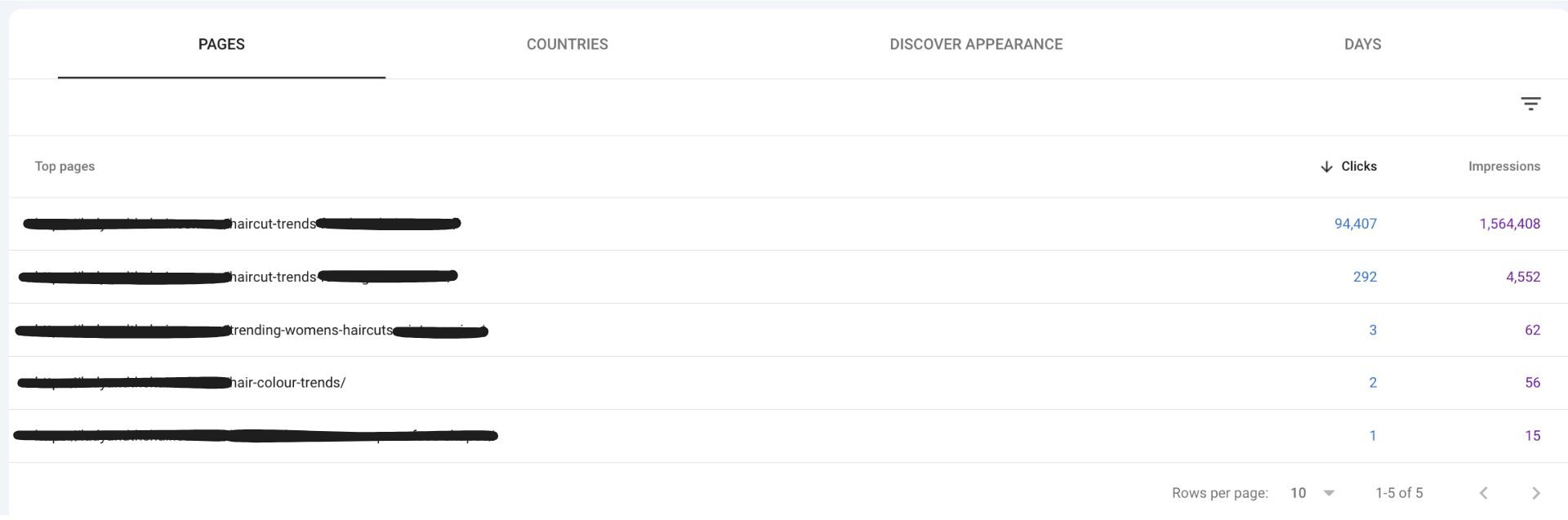
One piece of content. Written around a trending topic, framed with topical clarity, published at the right moment. This is what happens when a content strategy is built to align with how Discover surfaces information — not how search engines rank keywords.
Strategy Breakdown: What Made This Work
Instead of targeting "hair salon + city" keywords, the content strategy identified trending nodes — celebrity looks, seasonal styles, treatment shifts — and published clear, timely, contextual content around them before the peak. Discover rewards freshness and topical relevance, not keyword density.
The site reduced content noise and tightened its topical focus entirely around the hair niche. Unrelated content was removed or consolidated. This signal clarity helped Google's systems understand the site as a definitive authority in the hair space — a prerequisite for Discover eligibility at scale.
Brand signals — consistent NAP data, entity recognition, strong visual identity — were reinforced before the Discover traffic arrived. A strong brand signal tells Google the content source is trustworthy enough to surface to millions of users proactively, not just in response to a query.
Discover is a visual feed. Content that wins Discover must have strong visual signals — compelling featured images, clear headlines, and structure that Google can parse and preview confidently. Every trending article was framed and formatted to maximize Discover card appeal and click-through.
The same declarative, context-rich writing that fueled Discover growth also drove AI sessions from 12 to 1,536. Content written to clearly explain "what is this trend, why does it matter, and who is this brand" gives both Discover algorithms and AI engines the signals they need to recommend it.
The Numbers: From 18K to 188K Monthly Sessions
The organic traffic growth across the 13-month campaign tells a clear story: a slow, deliberate foundation phase followed by an exponential Discover-driven breakout. The GA4 data below shows the full picture — from initial baseline to peak performance.
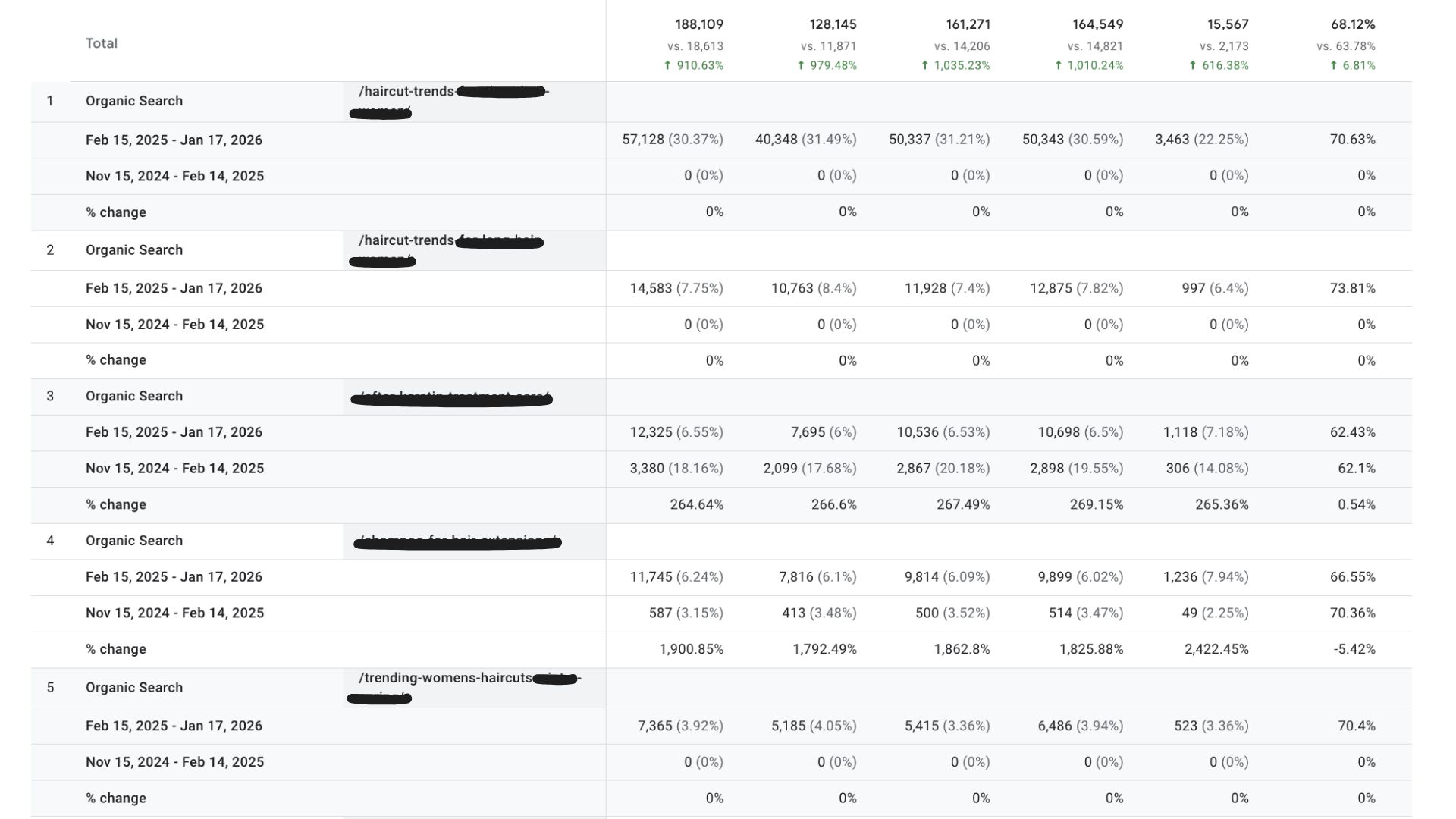
What is particularly significant is the AI session trajectory: growing from 12 to 1,536 — a 128× increase. This did not happen because AI platforms were separately targeted. It happened because the same content clarity and topical authority that fueled Discover also made the site's content highly extractable and citable by AI engines. The channels compound each other.
Local SEO no longer stops at the map pack. When a local brand earns topical authority and aligns with how Discover and AI systems surface information, visibility scales far beyond location-based queries — and bookings follow.
The booking conversion story is the most compelling metric: direct bookings grew from 204 to 1,824 per month — a 784% increase. This is the downstream proof that Discover traffic and AI sessions were not vanity metrics. They were converting visitors who arrived with genuine intent, reinforced by the trust signals the brand had built across every channel.
Key Takeaways: What This Case Study Proves
-
Trending content beats evergreen volume for local brands. Publishing fewer, better-timed articles around genuinely trending topics outperforms a strategy of publishing dozens of generic service pages. One article targeting a trending node delivered 94K clicks — more than most local sites achieve in a year of keyword-focused content.
-
Google Discover is an underutilized local SEO channel. Most local SEO strategies ignore Discover entirely. But for any brand in a visually driven niche — hair, beauty, food, fashion — Discover represents a massive untapped visibility channel that operates independently of traditional keyword rankings.
-
Topical focus matters more than topical breadth. Reducing content noise and tightening the site's topical authority around a single niche was a prerequisite for Discover eligibility. Scattered content signals dilute authority; focused signals compound it.
-
Discover authority and AI citation authority are the same thing. The content clarity that makes a page Discover-eligible makes it AI-citable. AI sessions growing from 12 to 1,536 was a direct byproduct of the same content strategy — not a separate initiative.
-
Timing is a strategic variable, not luck. Publishing content before a trend peaks — rather than reacting after it — is the core discipline of the Trending Nodes approach. Discover rewards freshness. Being first, with clarity, is a repeatable advantage.
-
Discover traffic converts when the brand is ready to receive it. Strong brand signals, a clear booking flow, and trust architecture meant that when 94K visitors arrived from Discover, the site was ready to convert them. Traffic without conversion infrastructure is wasted. This site had both.
Ready to Put Your Brand in Front of Discover & AI Audiences?
The Trending Nodes strategy is not a one-time tactic — it is a repeatable content framework that aligns your brand with how both Google Discover and AI engines surface information. Justin Hà applies this methodology to salons, restaurants, hotels, and any brand in a visually driven, trend-sensitive niche.
justinha.info.vn · Packages from USD 600/month · Available for salons, restaurants, hotels & travel brands